
Argentina's Polymarket Ban: When Prediction Platform Growth Meets Regulatory Reality
Discover the reasons behind Argentina's decision to ban Polymarket, examining concerns over inflation speculation, gambling regulation violations and the government's stance on prediction market platforms.

Key takeaways
- The comprehensive Polymarket prohibition enacted by Argentina demonstrates that expanding globally at high speed does not protect platforms from jurisdiction-specific regulations, particularly when fundamental operations mirror unregulated betting activities.
- Regulatory bodies employed an approach centered on "economic reality," prioritizing how users actually engage with the platform over its technological foundation, and determined that wagering funds on unpredictable events matches conventional gambling classifications.
- Insufficient identity verification systems and age-checking protocols emerged as significant regulatory concerns, with officials emphasizing dangers related to minors accessing the platform and inadequate protections for all participants as reasons for taking action.
- The presence of Argentina-specific inflation prediction markets on Polymarket amplified regulatory attention, sparking worries regarding privileged access to confidential information, the exploitation of critical economic statistics and possible manipulation of public sentiment.
Across the globe, prediction markets are experiencing remarkable popularity gains. Increasingly, users leverage these platforms as sophisticated forecasting mechanisms for subjects spanning from electoral politics to economic trends.
However, within Argentina's borders, this expansion has encountered substantial obstacles. Courts in Buenos Aires have ordered a nationwide prohibition of Polymarket, claiming the service functions as an unauthorized gambling operation lacking proper user protection measures.
The enforcement action highlights an expanding international conversation regarding whether prediction markets deserve classification as informational resources, financial trading instruments or variations of digital wagering platforms.
The following analysis examines Argentina's rationale for blocking Polymarket notwithstanding its worldwide expansion, investigating issues surrounding unlicensed gambling operations, inadequate participant safeguards and markets tied to inflation data. The discussion addresses how regulatory authorities increasingly evaluate prediction markets according to their actual economic function instead of their cryptocurrency-based technological framework.
A rapidly expanding platform meets firm legal resistance
Across global markets, Polymarket has positioned itself among the most prominent cryptocurrency-driven prediction platforms. Users place wagers across diverse future scenarios, encompassing political contests and macroeconomic measurements, utilizing stablecoins for transactions.
The platform's rapid ascent can be attributed to multiple fundamental factors:
- Rising interest in immediate, market-based prediction mechanisms
- Increased user activity surrounding major worldwide occurrences
- The distinctive proposition of converting expertise and foresight into monetizable financial positions
Despite this trajectory, the platform has attracted intensifying regulatory examination. Within Argentina's jurisdiction, such scrutiny has progressed to concrete enforcement measures.
Did you know? The history of prediction markets extends back multiple centuries. During the 1500s, individuals across Europe wagered on the outcomes of papal elections, demonstrating that betting on future occurrences existed long before contemporary cryptocurrency-enabled platforms emerged.
Enforcement measures taken by Argentina
Courts located in Buenos Aires issued orders requiring the country's national communications regulator, Ente Nacional de Comunicaciones (ENACOM), to implement comprehensive blocking measures against Polymarket and associated web domains across Argentine territory. The mandate encompasses:
- Delisting or limiting access to the platform's mobile applications within Google and Apple digital marketplaces for Argentine-based users
- Establishing access restrictions via internet service providers operating throughout the nation
Legal proceedings were initiated following an official complaint submitted by Lotería de la Ciudad de Buenos Aires (LOTBA), the governmental lottery authority for Buenos Aires City, with the case prosecuted by a specialized unit focusing on gambling-related criminal violations.
Despite originating from a municipal-level court system, the ruling's implementation reaches across the entire country, generating discussions about how geographically limited judicial determinations can create comprehensive digital access restrictions.
Regulators' rationale for deeming Polymarket unlawful
The fundamental argument presented by authorities remains uncomplicated. Whenever people risk actual monetary value on unknown future results, such activity qualifies as gambling.
Government officials in Argentina have essentially dismissed the platform's blockchain infrastructure and cryptocurrency components, instead implementing a pragmatic "economic substance" methodology that analyzes genuine user conduct.
According to this interpretation:
- Users deposit monetary resources as wagers
- Future results remain undetermined
- Financial returns correlate entirely with eventual outcome determinations
Such characteristics align precisely with established legal characterizations of gambling activities. Because Polymarket purportedly functions without obtaining necessary domestic licenses or governmental authorization, regulatory bodies maintain that operations breach national gambling legislation.
Concerns about identity verification and age controls
Among the authorities' principal objections involves weaknesses in participant protection systems. Officials asserted that Polymarket failed to implement sufficient:
- Comprehensive identity authentication procedures
- Reliable age confirmation systems
These deficiencies generate possibilities that:
- Minors might successfully access the platform and place wagers
- Participants could operate without appropriate oversight or verification
Within regulatory frameworks, these protective shortcomings alone provide adequate grounds for governmental action, irrespective of cryptocurrency technology involvement.
Did you know? The United States previously operated political futures markets through the University of Iowa, where participants exchanged contracts based on real monetary value tied to election results as components of academic research initiatives conducted by the institution.
Heightened scrutiny over inflation-related markets
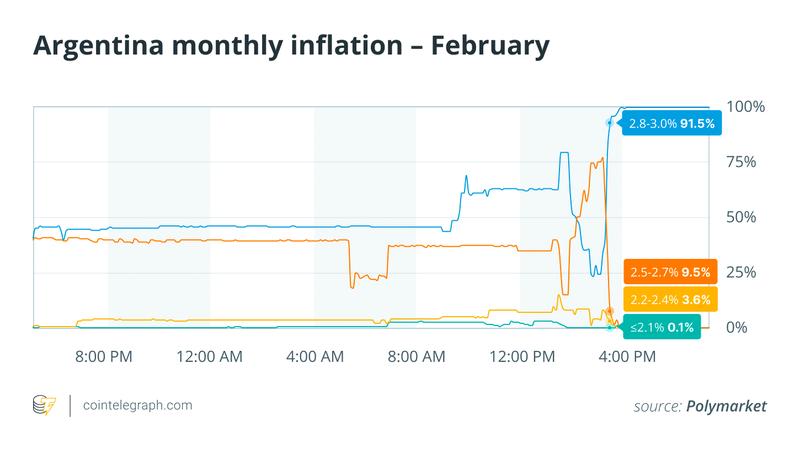
Given Argentina's ongoing economic difficulties, especially concerning elevated inflation rates, economic measurements carry substantial political and social importance. Among Polymarket's offerings were actively traded markets forecasting the nation's official inflation figures. On multiple occasions, market pricing demonstrated notable correlation with subsequently published official data.
Such correlations generated various concerns, including:
- Potential access to confidential or privileged information among market participants
- The monetization of sensitive governmental economic information
- Risks of market-influenced distortions affecting public understanding
Considering inflation's critical significance throughout Argentina, these factors substantially heightened regulatory concerns.
How global expansion fuels local regulatory pushback
The international scale achieved by Polymarket specifically renders the platform impossible for government authorities to overlook. As platform operations expand:
- User engagement numbers escalate dramatically
- Transaction volumes and capital flows grow substantially
- Media coverage and governmental attention multiply
What initially appeared as a novel technological experiment now presents itself as an unmonitored wagering infrastructure functioning beyond regulatory oversight. Throughout this evolution, the platform's accelerated growth directly contributed to attracting regulatory focus.
A growing pattern of global restrictions
Argentina's enforcement actions are not isolated incidents. Similar regulatory responses have materialized across multiple jurisdictions:
- Official cautions, operational restrictions or complete prohibitions across certain European jurisdictions
- Enforcement measures throughout portions of Latin American territories
- Continuing legal proceedings and compliance negotiations within the US
This emerging pattern indicates an unmistakable regulatory transformation. Government attention has shifted from examining technological infrastructure toward assessing functional characteristics. When platform operations functionally resemble gambling or uncontrolled financial speculation, regulatory bodies demonstrate greater willingness to impose relevant restrictions.
The enduring dilemma: Gambling versus financial innovation
Prediction markets occupy an ongoing regulatory ambiguous zone. Platform supporters argue that these services provide meaningful benefits through:
- Improving information discovery mechanisms and aggregating distributed knowledge
- Providing instantaneous, market-driven representations of collective forecasts
- Consistently outperforming traditional polling methodologies in predictive accuracy
Critics argue these platforms encourage:
- Primarily speculative betting behavior
- Insufficient safeguards for users
- Susceptibility to exploitation through insider knowledge or market manipulation schemes
This fundamental ambiguity creates classification challenges and enables authorities to more readily enforce existing gambling regulations.
Factors driving greater caution in Latin America
Territories throughout Latin America demonstrate heightened regulatory alertness attributable to:
- Significant economic instability and frequent volatility
- Elevated sensitivity surrounding financial data and macroeconomic indicators
- Emphasis on robust consumer protection frameworks
- Reduced acceptance of unregulated financial platform operations
Under such conditions, platforms facilitating real-money wagering, regardless of their presentation as predictive "markets," encounter increased likelihood of regulatory restrictions.
Did you know? Decentralized prediction market platforms frequently employ stablecoins rather than volatile cryptocurrencies to simplify outcome settlements and minimize participants' exposure to cryptocurrency price volatility throughout trading periods.
The striking paradox: a municipal ruling with nationwide effect
Although originating from a Buenos Aires municipal court system, the judicial order ultimately produced a countrywide Polymarket access prohibition. This outcome demonstrates the practical realities governing digital platform regulation:
- Platform services operate without geographical boundaries
- Enforcement mechanisms function at local levels
- Resulting impacts extend nationally
This dynamic also clarifies why platform users rapidly adopted circumvention technologies including virtual private networks (VPNs), underscoring the inherent limitations of geographically-bounded legal authority over globally interconnected internet infrastructure.
Implications for prediction markets going forward
Argentina's Polymarket enforcement episode reveals a crucial insight: Growth trajectories alone cannot guarantee regulatory acceptance or operational legitimacy. As these platform types continue expanding, operators will encounter:
- Intensifying regulatory examination
- Expanding requirements for jurisdiction-specific compliance
- Enhanced mandates for implementing participant protection mechanisms
Platforms currently functioning within ambiguous legal territories may eventually face choices between pursuing formal regulatory compliance and confronting ongoing access restrictions.