Analyst: Accumulation Surge Brings Bitcoin's $80K Target Back Into Focus
Bitcoin accumulation addresses have hit record demand levels, while market analysts point to an unfilled CME futures gap as a technical indicator supporting near-term price targets in the higher range.

After rallying past the $70,000 mark during weekend trading, Bitcoin (BTC) experienced a swift decline that pushed the price below $67,400 as Monday's trading session commenced. However, a rapid bounce-back could be on the horizon, supported by BTC order book information revealing aggressive bid placement, alongside blockchain metrics indicating an uptick in sustained, long-term accumulation activity.
Market analysts are now suggesting that the upward movement could potentially reach the $80,000–$84,000 zone, with order book liquidity serving as a crucial factor in determining the subsequent price action.
Key takeaways:
- The Bitcoin accumulator addresses held over 372,000 BTC on Feb. 15, up from 10,000 BTC in September 2024.
- BTC order books show the largest bid skew in over two years, signaling a stronger near-term support.
Order book metrics and Bitcoin futures data indicate potential $80,000 retest
According to crypto analyst Mark Cullen, Bitcoin could advance toward the CME (Chicago Mercantile Exchange) gap formed in early February, establishing $80,000 to $84,000 as his target ceiling for price movement this week.
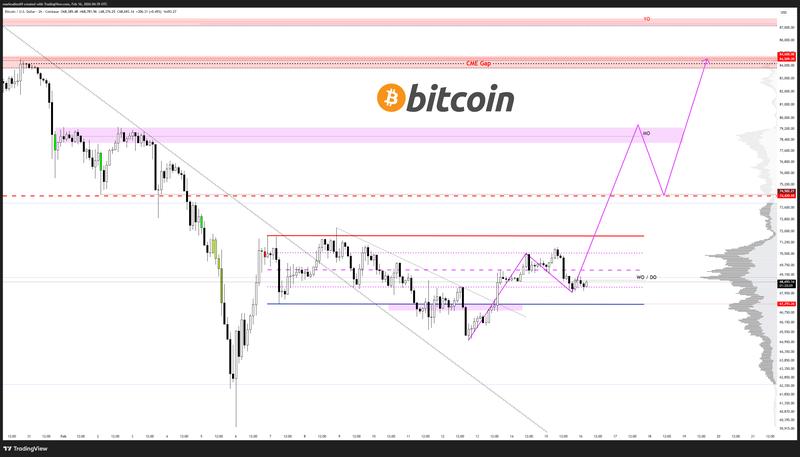
The formation of a CME gap occurs when Bitcoin futures trading on the Chicago Mercantile Exchange halts for the weekend period and resumes at a price point that differs from the closing level, creating an interval where no trading volume was recorded.
Historical patterns show that Bitcoin has frequently returned to these gaps in order to "fill" them, which means the price retraces through that previously untested price interval.
The existing gap is positioned approximately between $80,000 and $84,000, establishing it as a distinct technical threshold. Given that 9 out of 10 CME gaps have been filled since August 2025, the $80,000–$84,000 zone emerges as the primary unfilled target.
In parallel, order book information disclosed by crypto trader Dom reveals approximately $596 million in bid orders positioned within 0–2.5% of the current price compared to $297 million in ask orders. This roughly 2:1 bid-to-ask disparity marks the most substantial bid skew observed in more than two years.
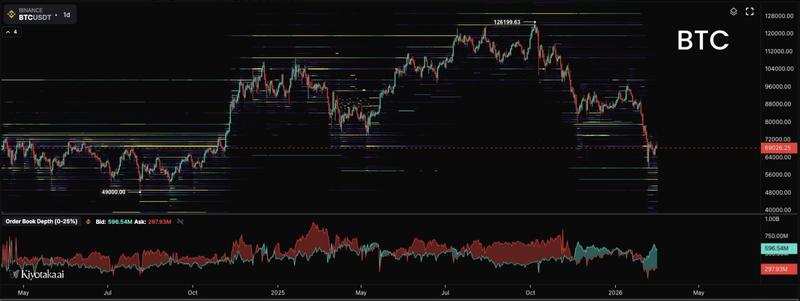
When a bid skew reaches this level of magnitude, it signals more robust immediate buying interest compared to available supply, which has the potential to underpin a near-term upward price trajectory if this condition persists.
According to Dom, market participants showed reluctance to purchase during the steep decline. Following Bitcoin's sweep beneath the $60,000 level, buying interest intensified near the bottom, pointing to increased appetite for accumulating at reduced price levels.
Bitcoin accumulation demand reaches record levels
Information from CryptoQuant demonstrates that demand from wallet addresses categorized as "accumulators" has climbed to unprecedented levels at approximately 372,000 BTC on Feb. 15. During September 2024, this metric registered at roughly 10,000 BTC.
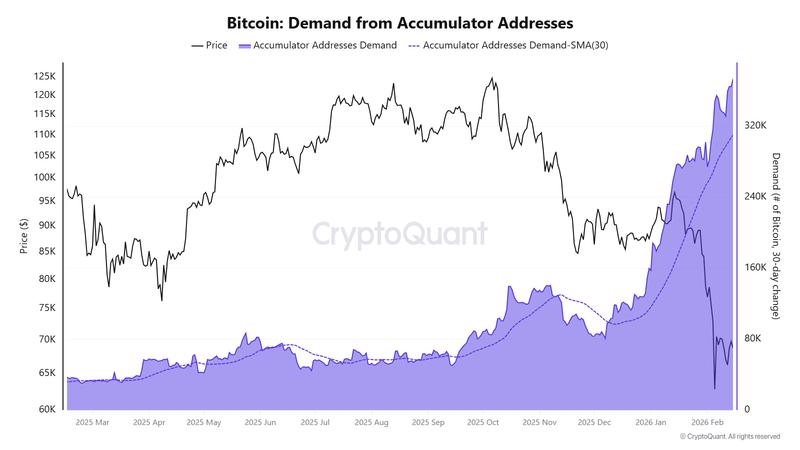
Cryptocurrency analyst Darkfost clarified that these wallet addresses undergo filtering based on rigorous standards: zero outbound transactions, multiple incoming transfers, a specified minimum balance requirement, a minimum of one active period within the previous seven years, and the exclusion of exchange wallets, mining addresses, and smart contract platforms.
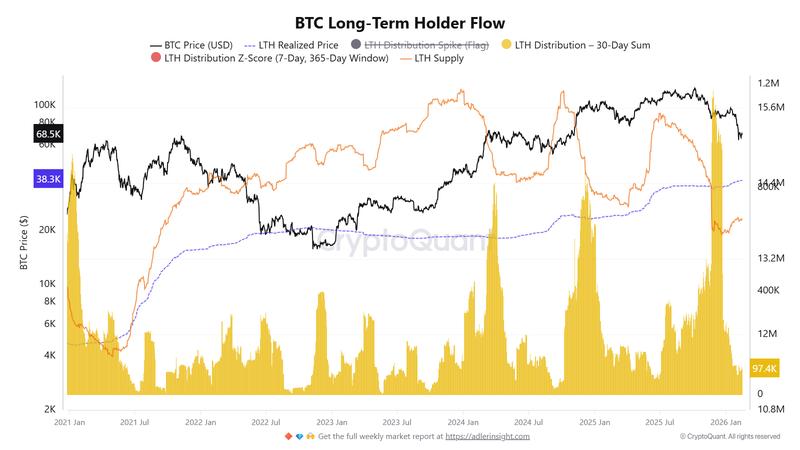
At the same time, the long-term holder (LTH) distribution 30-day sum, a metric that tracks the aggregate BTC transferred by long-term holders across a 30-day rolling window, has dropped beneath $100,000, in contrast to averages exceeding $1 million during November 2025.
When distribution metrics decline, this indicates diminished selling pressure from the LTHs, which serves to partially balance against the influx driven by large-scale holders.