
African Communities Choose Bitcoin Over US Dollars, Africa Bitcoin Corporation Chair Reports
Speaking with Natalie Brunell on the Coin Stories podcast, Stafford Masie characterized Bitcoin as a functioning medium of exchange across African regions experiencing severe inflation and currency deterioration.
On Tuesday, Stafford Masie, who serves as executive chairman of Africa Bitcoin Corporation, revealed that Bitcoin operates as daily transactional currency across various African regions instead of serving mainly as a value preservation tool.
During his Tuesday appearance on Natalie Brunell's Coin Stories podcast, Masie explained that the perception and utilization of Bitcoin (BTC) varies dramatically depending on geographic location.
"Where I come from, Bitcoin is money," Masie told Brunell, further noting that within certain circular economies across Africa, business owners "won't accept dollars — they accept satoshis."
In contrast to investors in developed nations who frequently highlight Bitcoin's function as protection against inflation, Masie portrayed communities where satoshis are used directly as transactional currency within local commercial ecosystems. He also drew attention to the dramatic disparity between inflation rates experienced in Western nations versus those in African regions.
"When you guys talk about debasement, you talk about 4% to 5% annually — we talk about 4% to 5% in an afternoon," he said.

Drawing parallels to Africa's swift embrace of mobile phone technology, Masie argued that the continent's younger demographic is leapfrogging traditional banking infrastructure. Instead of moving incrementally away from stable national currencies, he portrayed a direct transition from what he termed "broken money" and extreme currency deterioration straight into digital asset adoption.
He further emphasized the significance of Africa's young population structure, observing that over 25% of the continent's inhabitants are younger than 20 years old. According to Masie, these younger demographics are readily adopting cutting-edge technologies including artificial intelligence, and they "love Bitcoin."
According to Masie, within this framework, Bitcoin transcends the role of a simple passive value storage mechanism. He instead characterized it as "pristine capital;" a foundational financial layer upon which both individuals and commercial enterprises can construct. He said:
In Africa, we know the age before 2008 and the age after 2008. After the Bitcoin white paper and before the Bitcoin white paper. Our lives changed, because suddenly we had something that couldn't be debased. It was immutable, decentralized, can't be confiscated. That to an African is life or death.
As a veteran technology executive, Masie previously held leadership positions overseeing significant technology operations throughout South Africa.
Crypto adoption in Africa
Information from Chainalysis, a blockchain analytics firm, seems to corroborate the continental transformation that Masie is articulating.
Between July 2024 and June 2025, the Sub-Saharan Africa region processed over $205 billion in onchain transaction value, representing a 52% increase compared to the previous year, positioning it as the world's third-fastest expanding crypto marketplace. During March 2025 specifically, monthly transaction volume surged to approximately $25 billion, propelled predominantly by Nigerian activity following a national currency devaluation event.
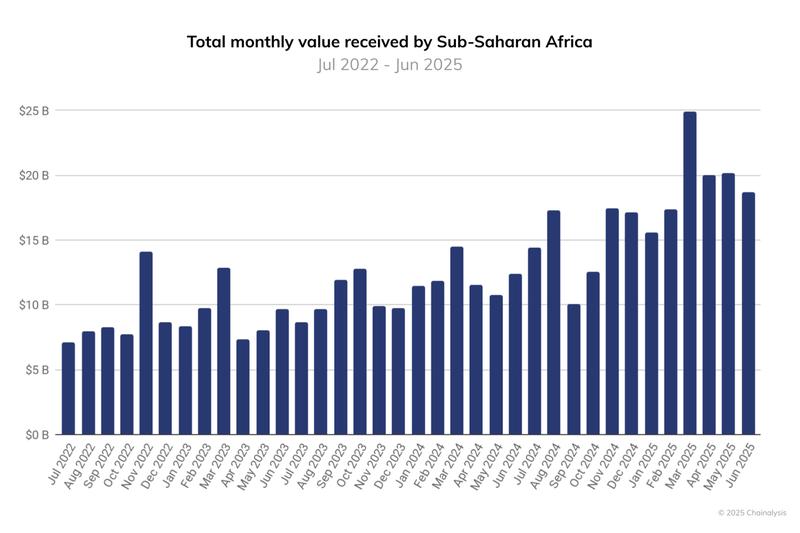
Sub-Saharan Africa has additionally distinguished itself as a cryptocurrency market dominated by retail participation. Transactions valued below $10,000 represented over 8% of aggregate value transmitted within the region throughout this identical timeframe, contrasted with approximately 6% on a worldwide basis, based on the report published in September.
Simultaneously, both Nigeria and South Africa demonstrated considerable institutional participation, with onchain transaction flows revealing repeated multimillion-dollar stablecoin movements associated with international commerce between African nations, the Middle East and Asian markets.
During January remarks at the World Economic Forum, Vera Songwe, former UN Under-Secretary-General, elaborated on how stablecoins are progressively recognized as more economical remittance and settlement mechanisms throughout Africa.
According to Songwe, remittance flows have emerged as "more important than aid" across numerous African economies, whereas conventional transfer methods can impose costs around $6 for every $100 transmitted. Given that inflation surpasses 20% in roughly a dozen nations and an estimated 650 million individuals lack banking access, she indicated that stablecoins provide both a payment infrastructure and a value preservation instrument in markets confronting currency instability.