Why Chainlink's Sergey Nazarov Sees This Crypto Downturn As Uniquely Different
According to Chainlink co-founder Sergey Nazarov, the current cryptocurrency market decline has unintentionally demonstrated 'how far the industry has progressed.'

According to Chainlink co-founder Sergey Nazarov, the current cryptocurrency market decline stands apart from any past bear market — notably, there have been no significant collapses resembling FTX, and the expansion of tokenized real-world assets (RWA) continues to show impressive momentum.
While market cycles represent a normal phenomenon, "but what is important is what those cycles reveal about how far the industry has progressed," Nazarov stated on X on Tuesday.
The total cryptocurrency market capitalization has experienced a 44% decline from its October all-time high of $4.4 trillion, witnessing nearly $2 trillion departing the sector within a mere four-month period.
Despite this, Nazarov appeared unfazed, pointing to two key factors that distinguish the current bear market from its predecessors.
In contrast to earlier cycles, like the FTX collapse and crypto lending catastrophes of 2022, the current drawdown has witnessed no significant institutional failures, demonstrating the industry's improved ability to manage volatility with greater reliability, according to his assessment.
"There have been no large risk management failures leading to large institutional failures or widespread systemic risks."
RWA growth will drive institutions and infrastructure
The second point he raised is that RWA tokenization and on-chain perpetual contracts for conventional commodities are continuing to advance at pace irrespective of cryptocurrency valuations, demonstrating that this technological innovation possesses independent value beyond mere speculative activity.
The onchain value of tokenized RWA has grown by 300% throughout the previous 12 months, based on data from RWA.xyz.
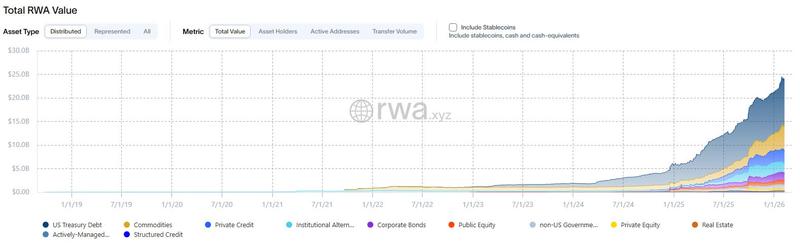
This development indicates that the presence of real-world assets on-chain "is not tightly coupled to cryptocurrency prices but provides its own unique value that can grow irrespective of market pricing of Bitcoin or other crypto assets," according to his statement.
Despite this surge, the price of Chainlink (LINK) has not mirrored this growth, with the blockchain oracle and RWA-focused asset plummeting 67% from its October high point, and currently down 83% since reaching its 2021 all-time high, exchanging hands below $9 at the time of writing, representing a bear market low.
Beyond these two factors, Nazarov identified additional converging trends that are reshaping cryptocurrency's trajectory.
The unique value proposition offered by on-chain perps and tokenization, including around-the-clock markets, on-chain collateral mechanisms, and real-time data accessibility, continues to expand steadily. This fundamental utility will be the driving force behind institutional adoption, while infrastructure demand will experience a surge as increasingly complex RWAs necessitate more advanced on-chain systems, according to the Chainlink co-founder's analysis.
"If these trends continue, I believe what I have been saying for years will happen; on-chain RWAs will surpass cryptocurrency in the total value in our industry, and what our industry is about will fundamentally change."
Not all bear markets are equal
Gautam Chhugani, an analyst at Bernstein, shared similar views in a note released Monday, noting that we are witnessing "the weakest Bitcoin bear case in its history."
"The current Bitcoin price action is a mere crisis of confidence. Nothing broke, no skeletons will show up," the analysts led by Chhugani stated.
According to Jeff Mei, chief operating officer at the BTSE exchange, who spoke with Cointelegraph, this particular sell-off stands apart "in that it was caused largely by non-crypto catalysts."
These catalysts include concerns that a weakening AI technology boom might trigger a stock market crash, "compounded by the appointment of Kevin Warsh to Fed chair, who many believe will reduce liquidity in the financial system," according to his explanation.