WhatsApp Privacy Controversy: Meta Representative Refutes Chat Access Claims During Legal Battle
A lawsuit filed in a US district court alleges that Meta maintains backdoor access to WhatsApp conversations, raising concerns about privacy protections for the platform's user base exceeding 3 billion people.
A top-level representative from Meta has pushed back against allegations suggesting the company possesses the ability to view WhatsApp conversations, following the filing of legal action against Meta last Friday. The executive maintains that the platform's end-to-end encryption technology ensures message security functions exactly as advertised to users.
During a Monday posting on the X platform, Andy Stone, who serves as communications director for Meta, stated: "Any claim that people's WhatsApp messages are not encrypted is categorically false and absurd," simultaneously characterizing the legal challenge as a "frivolous work of fiction."
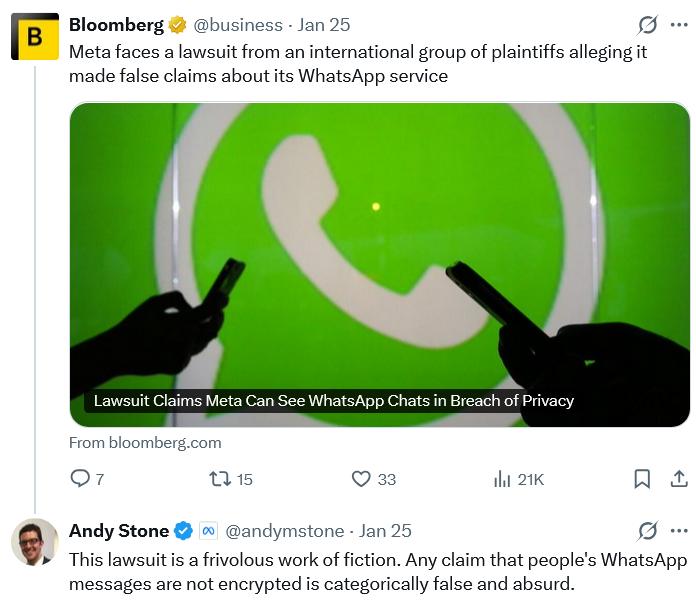
The legal complaint was submitted to a US district court located in San Francisco, California, this past Friday by a collective of WhatsApp users residing in nations including Australia, Mexico, South Africa and India.
Those bringing the lawsuit have characterized Meta's end-to-end encryption capability as a sham and are pursuing monetary damages from the social media corporation.
The legal action seeks to "expose the fundamental privacy violations and fraud" that Meta is purportedly committing against its user base who utilize the messaging application under the assumption that their communications remain completely private.
Pavel Durov, the CEO of WhatsApp rival Telegram, threw support behind the suit, stating: "You'd have to be braindead to believe WhatsApp is secure in 2026. When we analyzed how WhatsApp implemented its 'encryption', we found multiple attack vectors."
Although Meta hasn't issued a public statement, Meta states in its end-to-end encryption explainer page that the "End-to-end encryption helps protect your privacy by ensuring no one sees your messages except you."
Privacy concerns have become an increasingly significant issue for individuals using centralized messaging platforms, with a growing number seeking enhanced control over their personal data in the online environment.
Bitchat emerges as a decentralized alternative
The legal proceedings initiated against Meta come on the heels of increasing adoption rates for decentralized, encrypted messaging applications such as Bitchat in regions experiencing conflict and disaster situations, which utilizes Bluetooth mesh networks to enable internet-free, private communication capabilities.
The application launched by Jack Dorsey has experienced a dramatic surge in downloads across Uganda, Iran, Nepal, Indonesia, Jamaica, and additional countries in recent times — whether as a reaction to governmental restrictions on social media access in those territories or to preserve communication capabilities during natural disaster events.
Additional decentralized messaging platforms that incorporate end-to-end encryption features include Session and X-Messenger.