USDT circulation poised for steepest monthly contraction since FTX's 2022 downfall
The supply of Tether's USDT stablecoin is approaching its most significant monthly contraction since FTX imploded, as major investors and sophisticated traders persistently decrease their USDT positions.

USDT from Tether, which holds the position as the globe's most valuable stablecoin pegged to the United States dollar, is on a trajectory toward its most dramatic monthly contraction in multiple years as major token holders accelerate their redemption activities, blockchain analytics reveal.
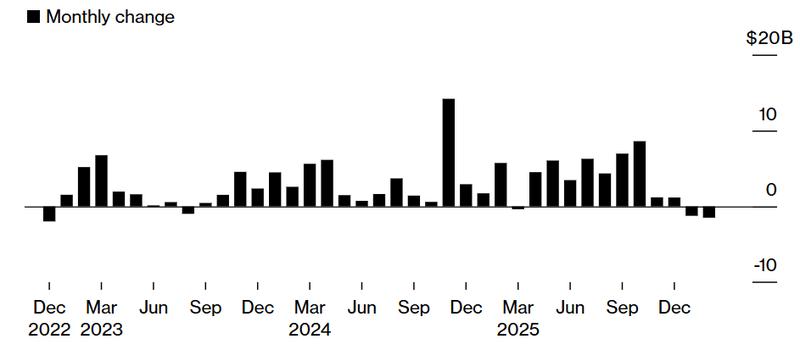
Throughout February, the active supply of USDt (USDT) has contracted by approximately $1.5 billion, coming after a $1.2 billion reduction witnessed in January, based on information from Artemis Analytics cited by Bloomberg. This trajectory positions USDT for its most substantial monthly reduction in a three-year period, dating back to the weeks following the November 2022 implosion of cryptocurrency platform FTX.
In December 2022, USDT supply experienced a $2 billion contraction following the dramatic collapse of FTX along with its 150 affiliated entities, which triggered widespread disruptions throughout the cryptocurrency sector.
This contraction could indicate a reduction in available liquidity within cryptocurrency markets, given that Tether's USDT serves as the principal entry point for individuals investing in digital assets. With a market capitalization standing at $183 billion, it represents approximately 71% of the entire stablecoin marketplace, per CoinMarketCap statistics.
Cointelegraph contacted Tether to inquire about the factors behind the supply reduction occurring in February, though no response had been obtained at the time of publishing.
Total stablecoin market cap flat in February
The reduction observed in USDT has not resulted in a corresponding decline throughout the wider landscape of dollar-pegged stablecoins.
The combined market capitalization encompassing all stablecoins operating across various exchanges has climbed 2.33% during February thus far, advancing from $300 billion to $307 billion, per data tracked by DeFiLlama.
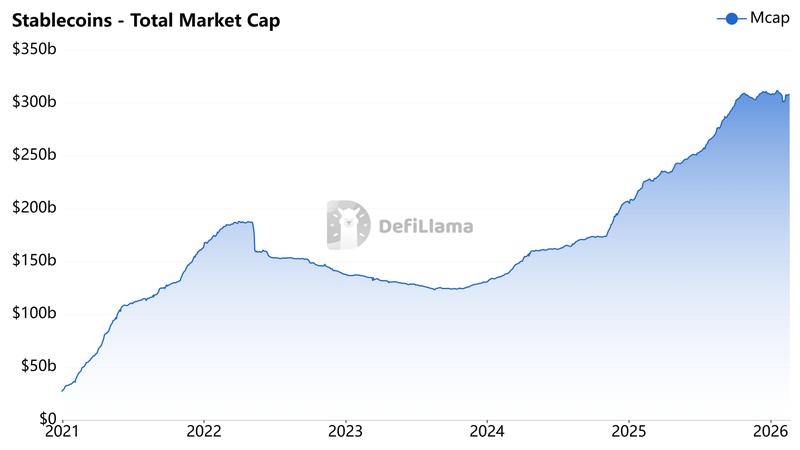
Although the two dominant stablecoins, USDT and Circle's USDC (USDC), both experienced decreases of 1.7% and 0.9%, respectively, the USD1 (USD1) stablecoin associated with World Liberty Financial, which has Trump family connections, saw its market capitalization surge by 50% throughout the previous month and reached a valuation of $5.1 billion as of Friday, based on DeFiLlama information.
Whales and smart money traders offload USDT, but fresh wallets stepping in
Major cryptocurrency investors, commonly referred to as whales, have been actively reducing their USDT allocations, though newly created accounts are introducing additional demand for the dominant stablecoin.
Wallets belonging to whales disposed of $69.9 million USDT distributed across 22 separate wallets throughout the previous seven-day period, representing a 1.6-fold escalation in this group's rate of selling activity, per data from Nansen, a crypto intelligence service.
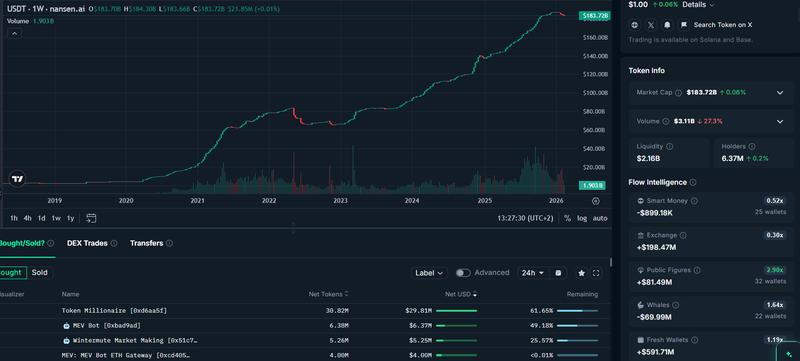
Those traders achieving the highest returns, categorized as "smart money," have similarly been net distributors of USDT. Simultaneously, wallets established within the most recent 15-day window acquired approximately $591 million in USDT value during the week, according to the analytics platform.
These divergent transaction flows underscore a marketplace division between significant token holders who are either redeeming their positions or redistributing their capital and newcomers entering the market to assume the opposite position, even while the overall issuance of stablecoins continues to demonstrate relative stability.