Trump criticizes banking sector for blocking cryptocurrency legislation progress
The president has called on financial institutions to negotiate fairly with cryptocurrency companies, describing efforts to weaken the GENIUS Act as unacceptable behavior.

President Donald Trump has criticized banking institutions for their role in preventing the Senate from advancing legislation that would establish a regulatory framework for the cryptocurrency market, with the dispute centering on provisions related to yield payments on stablecoins.
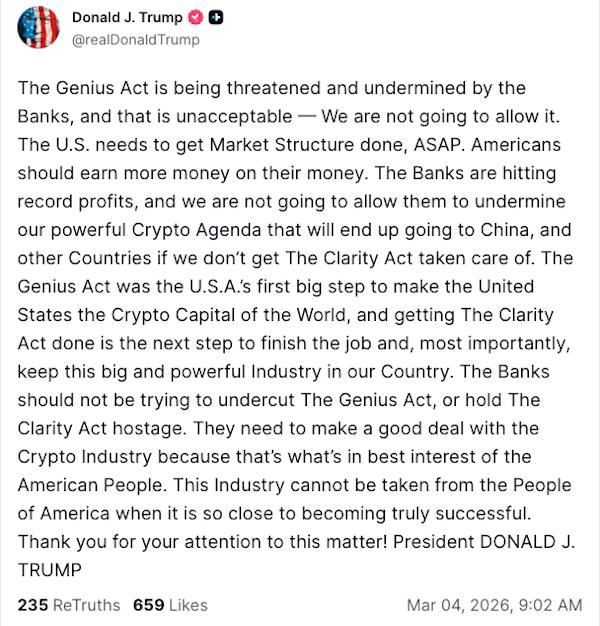
In a Tuesday post on Truth Social, Trump referenced the GENIUS Act—legislation that Congress approved in July to establish stablecoin regulations—stating, "The Genius Act is being threatened and undermined by the Banks, and that is unacceptable — We are not going to allow it."
"The U.S. needs to get Market Structure done, ASAP," he added. "The Banks are hitting record profits, and we are not going to allow them to undermine our powerful Crypto Agenda that will end up going to China, and other Countries if we don't get The Clarity Act taken care of."
The president has promoted the GENIUS Act as a landmark accomplishment designed to make the United States an attractive destination for cryptocurrency businesses. While the legislation establishes a regulatory pathway for stablecoin issuers, it prohibits these companies from directly providing yield payments to those who hold their tokens.
Despite this restriction, third-party services including cryptocurrency trading platforms retain the ability to provide yield opportunities to users maintaining stablecoin balances.
Financial industry trade organizations contend that this arrangement represents a regulatory gap and are advocating for the Senate's cryptocurrency market structure legislation to incorporate a comprehensive prohibition on any form of stablecoin yield payments. The House of Representatives approved its corresponding legislation, known as the CLARITY Act, in July.
Trump stated, "The Banks should not be trying to undercut The Genius Act, or hold The Clarity Act hostage. They need to make a good deal with the Crypto Industry because that's what's in best interest of the American People."
Leadership figures and advocacy representatives from the cryptocurrency sector have opposed banking industry attempts to incorporate a prohibition on stablecoin yield payments into the proposed legislation, with prominent lobbying organization Coinbase withdrawing its backing for the bill in January due to this specific concern.
Progress on the bill has ground to a halt following the Senate Banking Committee's decision to delay markup proceedings after Coinbase retracted its support in January, with no subsequent date established for legislative review.
Trade associations representing banking interests have argued that allowing stablecoin yield payments would result in capital flowing out of traditional bank accounts into stablecoins, potentially jeopardizing the overall stability of the banking sector.
Representatives from both the cryptocurrency and banking industries have participated in three separate negotiating sessions at the White House during the current year in an attempt to develop mutually acceptable legislative language that would enable the bill to advance, though these discussions have not yet produced an agreement.
The president is seeking passage of the legislation as a significant policy achievement to highlight during the November midterm elections, with cryptocurrency advocacy organizations having amassed over $200 million in funding to support candidates who favor the industry.
Hill says Senate should consider passing House bill
During a Tuesday event, Representative French Hill, a senior member of the Republican caucus serving as chair of the House Financial Services Committee, suggested that the Senate should give serious consideration to adopting the House's cryptocurrency legislation if progress on the Senate's own version remains blocked.
According to Hill, the CLARITY Act passed by the House had "reasserted the language in [the GENIUS Act] on a bicameral, bipartisan basis, that stablecoins were a payment device on a blockchain and not an investment device, that they would not pay interest, per se."
"If the Senate can't come to a straightforward conclusion here, I recommend they use the language that we have in the House-passed Clarity Act with 78 Democratic votes on it, and use that as the solution," he said.