Treasury Faces Democratic Scrutiny Over World Liberty's Banking Application and Emirates Investment
Democratic lawmakers are challenging Treasury Secretary Scott Bessent regarding World Liberty Financial's application for a national trust bank charter, raising concerns about systemic risks to the financial system.

Members of the Democratic Party serving in the United States House of Representatives are challenging Treasury Secretary Scott Bessent regarding the regulatory approach to World Liberty Financial's application for a national trust bank charter, which would enable the company to issue a token backed by the US dollar.
Through a letter dated Feb. 19, a group of 41 Democratic members of the House Financial Services Committee, spearheaded by Representative Gregory Meeks, raised concerns about systemic risk, foreign ownership issues, and the possibility of political influence affecting the bank charter approval process.
The representatives requested that Bessent provide details on what protective measures are in place to prevent foreign government representatives or investors with political connections from exploiting the charter approval system to establish influence over America's financial infrastructure.
The members of Congress referenced news reports indicating that a high-ranking member of the United Arab Emirates royal family discreetly purchased approximately half of World Liberty Financial's ownership for around $500 million, with reports suggesting that $187 million was directed to entities associated with Trump, all while the firm was seeking a national trust bank charter through the Office of the Comptroller of the Currency (OCC).
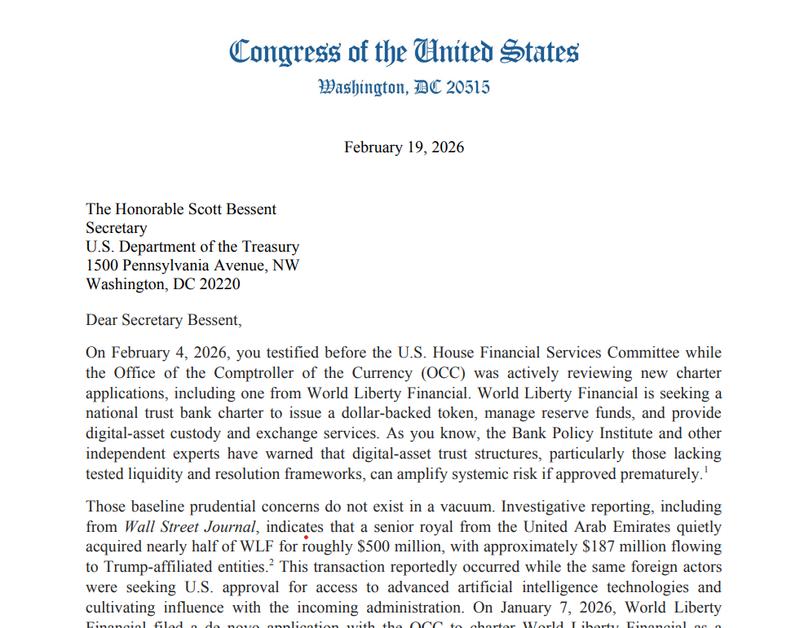
The lawmakers contended that the convergence of digital asset trust frameworks, unproven liquidity and resolution mechanisms, and foreign political involvement created concerns that financial regulators "cannot afford to sidestep."
The Democratic representatives also raised questions about whether Executive Order 14215, which they assert brought traditionally independent financial regulatory bodies under tighter White House supervision, might undermine the OCC's independence when evaluating World Liberty's charter application.
The correspondence requests that Bessent provide comprehensive information about the involvement of the White House, the Office of Management and Budget, and the Treasury Department in OCC charter approval processes, with a written response deadline of Feb. 26.
World Liberty Financial's high profile
The correspondence comes at a time when World Liberty Financial and additional crypto ventures associated with Trump are increasing their visibility in Washington and among Wall Street circles, highlighted by a heavily attended cryptocurrency event hosted at Trump's Mar-a-Lago club on Wednesday that attracted executives from both the crypto industry and traditional financial institutions, including Coinbase CEO Brian Armstrong, Binance co-founder Changpeng Zhao and Goldman Sachs CEO David Solomon.
No bailout of "cryptocurrency billionaires"
In a separate development, Senate Banking Committee Democratic Senator Elizabeth Warren called on Bessent and Federal Reserve Chair Jerome Powell on Wednesday to avoid using taxpayer-supported measures to prop up cryptocurrency markets. She cautioned that any financial rescue of "cryptocurrency billionaires" would establish a moral hazard and transfer losses from wealthy investors to ordinary taxpayers.
Warren's correspondence characterized potential rescue operations for significant crypto companies and investors as a crucial test of whether government officials would expand bank-style safety nets to the digital asset industry, occurring at a time when regulators are evaluating new charter applications and oversight mechanisms for institutions linked to cryptocurrencies.