Polymarket files federal lawsuit against Massachusetts over state regulation of prediction markets
In a federal court challenge, Polymarket contends that Massachusetts has no jurisdiction to oversee prediction markets already approved by the CFTC.

In a federal legal action against Massachusetts, Polymarket contends that the Commodity Futures Trading Commission (CFTC) has been given sole jurisdiction by Congress over event contracts, which bars individual states from unilaterally closing down prediction markets that operate under federal oversight.
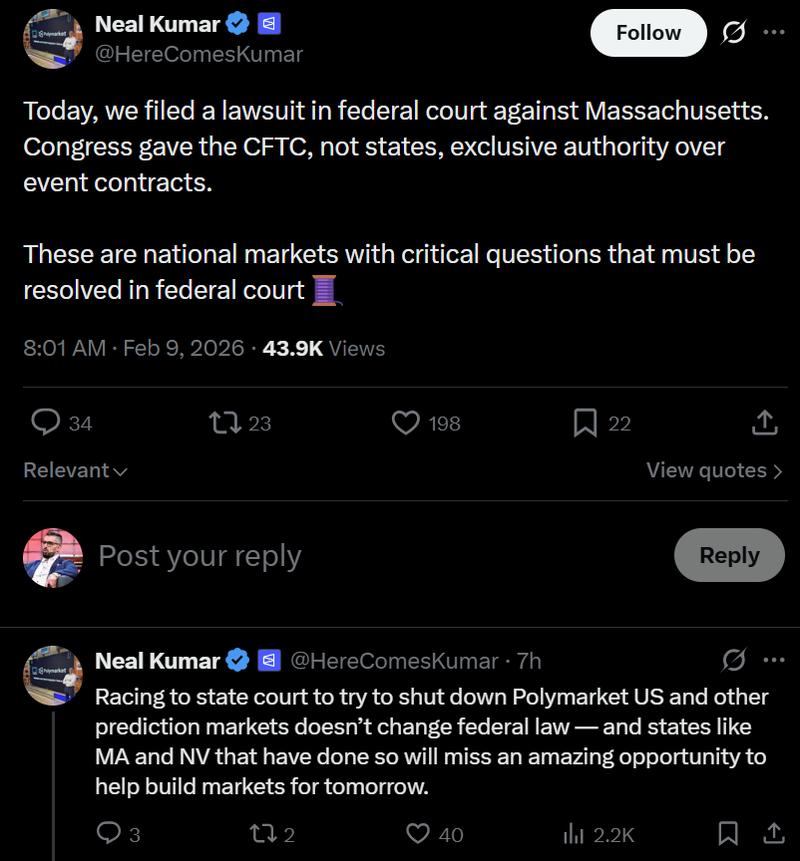
On Monday, Neal Kumar, who serves as chief legal officer at Polymarket, publicly acknowledged the legal filing, explaining that the matter concerns markets operating nationwide and presents unresolved questions of law that require federal rather than state-level resolution.
Racing to state court to try to shut down Polymarket US and other prediction markets doesn't change federal law — and states like MA and NV that have done so will miss an amazing opportunity to help build markets for tomorrow
Neal Kumar, Polymarket's chief legal officer
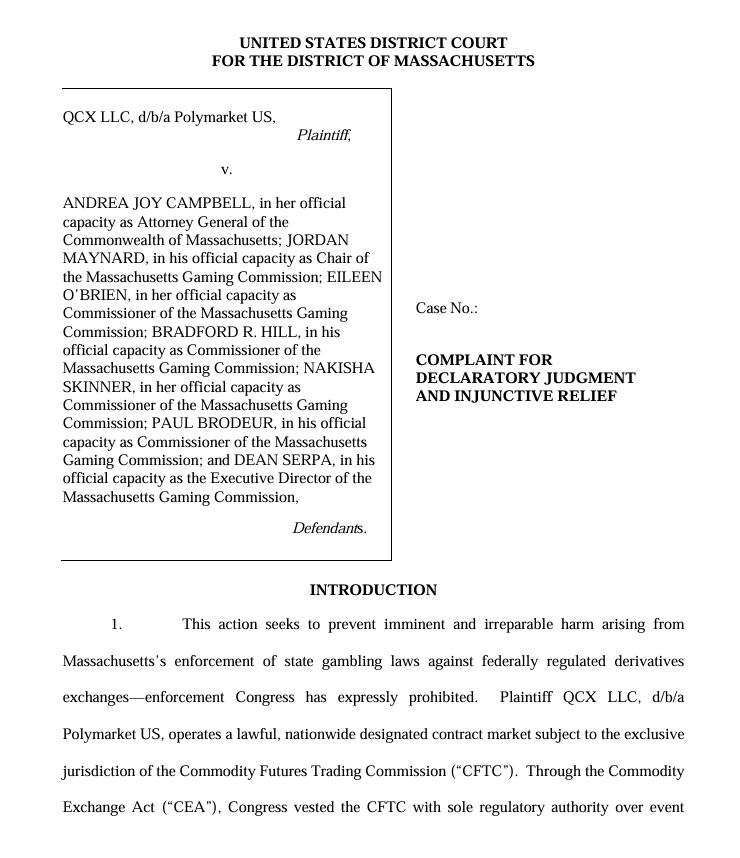
According to Bloomberg Law's reporting, the legal action was initiated as a preemptive measure designed to prevent possible enforcement measures by Andrea Campbell, the Attorney General of Massachusetts, which Polymarket contends would represent an unlawful intrusion into derivatives markets operating under federal regulation.
This legal action arrives on the heels of a Massachusetts state court decision that issued a preliminary injunction preventing Kalshi, a competing prediction market platform, from making sports-related contracts available to residents within the state.
The lawsuit also follows by one week a Nevada court decision that prevented Polymarket from providing sports contracts to state residents, with the judge citing potential "irreparable" damage to Nevada's capacity to uphold the integrity of its regulatory framework for sports betting, as Cointelegraph previously reported.
Prediction markets face growing state scrutiny as volumes surge
Cointelegraph's previous coverage has shown that Nevada and Massachusetts are far from alone in their opposition to prediction markets. According to Kalshi's records, a minimum of eight additional states, among them New York, Illinois and Ohio, have initiated actions to either limit or legally contest prediction markets focused on sports.
This wave of regulatory resistance is occurring despite prediction markets experiencing substantial expansion in recent months. Information from Dune demonstrates that prediction markets achieved $3.7 billion in trading volume over a single week in January, establishing a new record high.
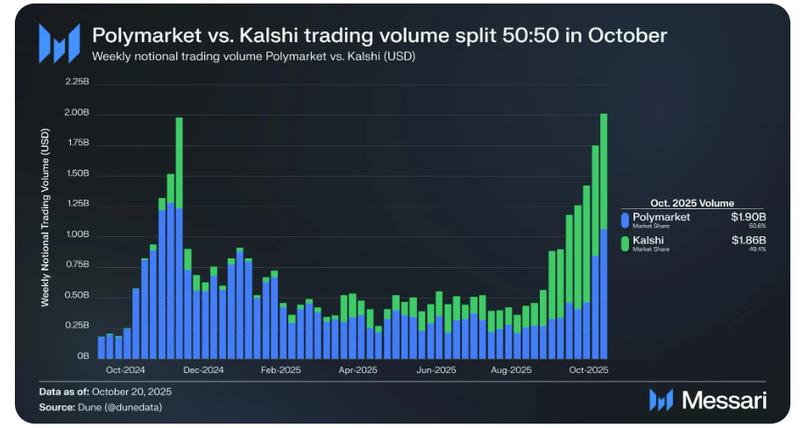
Additional information from Messari reveals that Polymarket and Kalshi are presently running approximately even in terms of trading volume, notwithstanding their different operational models, with Polymarket functioning on decentralized infrastructure.
Both platforms have attracted substantial venture capital investment, with Polymarket achieving a valuation of $9 billion and Kalshi reaching $11 billion after completing their latest rounds of fundraising.