Negative Bitcoin funding rates emerge: Is bearish sentiment becoming excessive?
Despite market headwinds from geopolitical instability and disappointing employment figures, strong institutional accumulation under $75,000 could deplete available supply and trigger an upward rally.

Bitcoin (BTC) encountered resistance when attempting to surpass the $71,000 threshold on Thursday, influenced in part by declining US equity markets, as BTC funding rates continued their descent into negative territory.
Key takeaways:
- Bearish sentiment on Bitcoin intensifies with declining funding rates, though consistent institutional accumulation prevents sellers from dominating the market.
- Rising gold prices and government bond yields present competitive challenges for Bitcoin's position as a premier store of value.
Moderate market stress reflected in Bitcoin futures
Market participants are concerned that an extended conflict in Iran could disrupt energy markets significantly, further damaging an already fragile global economic outlook.
The perpetual futures market for Bitcoin exhibited indicators of moderate strain, suggesting a possible retest of the $66,000 level. Nevertheless, institutional capital inflows demonstrate growing demand, which diminishes the likelihood of a substantial Bitcoin price decline.
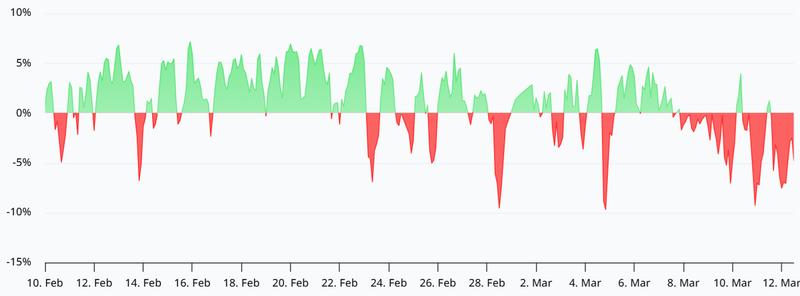
On Thursday, the annualized funding rate for Bitcoin perpetual futures fell to -7%, indicating that short position holders (sellers) were compensating to maintain their bearish bets.
While the increasing confidence among bears raises concerns, the absence of enthusiasm from long position holders (buyers) is understandable, considering Bitcoin remains 45% beneath its all-time high.
Muted activity in Bitcoin's derivatives market
The technology-focused Nasdaq 100 index was trading just 6% below its peak on Thursday. Similarly, the US-listed Russell 2000 Index, which tracks small capitalization stocks, was positioned 9% away from its record high.
Consequently, deteriorating economic fundamentals or concerns about supply chain disruptions stemming from Middle Eastern tensions cannot adequately explain Bitcoin's underwhelming performance.
Thursday's release of the most recent US unemployment figures showed 1.85 million continuing claims for the week concluding on Feb. 28, marginally exceeding expectations, according to Yahoo Finance.
US President Donald Trump pledged to "finish the job" in Iran, a military engagement that compounds the government's fiscal debt challenges and offers no relief to labor market conditions.
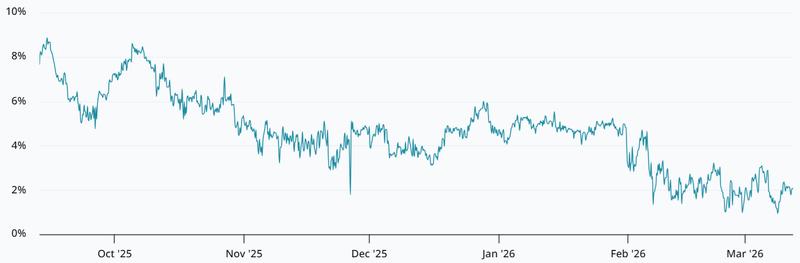
For several weeks now, the premium on Bitcoin monthly futures compared to conventional spot markets has remained beneath the neutral 5% benchmark. However, while this situation is far from optimistic, there is no clear indication that Bitcoin derivatives are currently signaling ongoing distress.
This diminished interest reflects Bitcoin's inability to achieve upward momentum despite expectations of monetary policy expansion.
Increasing institutional appetite could propel BTC past $75,000
The robust performance of gold above $5,100 challenges Bitcoin's narrative as a store of value, particularly as US bond yields experienced sharp increases during March, indicating that investors are requiring greater compensation for holding these securities.
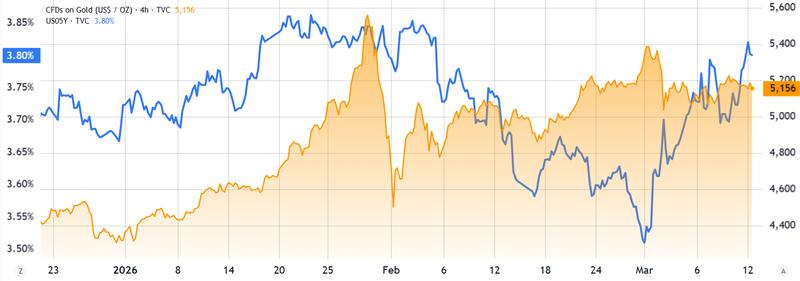
On Thursday, yields on 5-year US Treasuries climbed to 3.80% after falling below 3.50% during late February. Consequently, market participants withdrew from fixed-income assets.
The US Federal Reserve faces a challenging dilemma, as reducing interest rates would support employment growth and mitigate credit market vulnerabilities. However, escalating oil prices continue to exert persistent upward pressure on inflation rates.
Currently, Bitcoin's predetermined and visible monetary framework is not being recognized as a safe haven asset, though this perception may shift as institutional buying activity increases.
Furthermore, relying solely on one Bitcoin derivatives indicator (funding rates) should not be viewed as evidence of an imminent severe price correction.
This is especially true given the recent pattern of net inflows into Bitcoin spot exchange-traded fund (ETF) products and Strategy (MSTR US) yield instruments, which have accelerated Bitcoin acquisition. Supply from sellers operating below $75,000 will ultimately be exhausted, creating conditions for a sustained bull run.
According to Cointelegraph's previous reporting, Bitcoin bulls will probably need to exercise patience until after March for an opportunity to overcome the $78,000 resistance level.