Key Bitcoin metrics surge as price remains stagnant: Understanding what indicators truly count
While institutional capital flows into Bitcoin slow down, network users and committed long-term holders continue accumulating available supply. During periods of sideways price movement, monitoring these specific indicators becomes essential.

Following a 35% decline occurring from Jan. 14 through Feb. 5, Bitcoin (BTC) has remained confined within a trading corridor spanning $60,000 to $70,000 throughout the most recent 22-day period. During this same timeframe, multiple metrics associated with BTC adoption have demonstrated varied trajectories among exchange-traded funds (ETFs), large-scale holders, mining operations, and companies maintaining Bitcoin reserves.
Such variations underscore ongoing capital allocation occurring behind relatively quiet price movements and reveal the role each indicator plays within the broader market context.
US spot Bitcoin ETF flows continue trending negative
The rolling 90-day average tracking net flows for US spot Bitcoin ETFs has declined to a level of -$2.18 billion. Throughout the preceding two-year period, this particular metric has registered negative territory on just two occasions: during the window from March 2025 through May 2025, and within the present period that commenced on December 11, 2025. During each of these episodes, Bitcoin subsequently entered a corrective market phase.
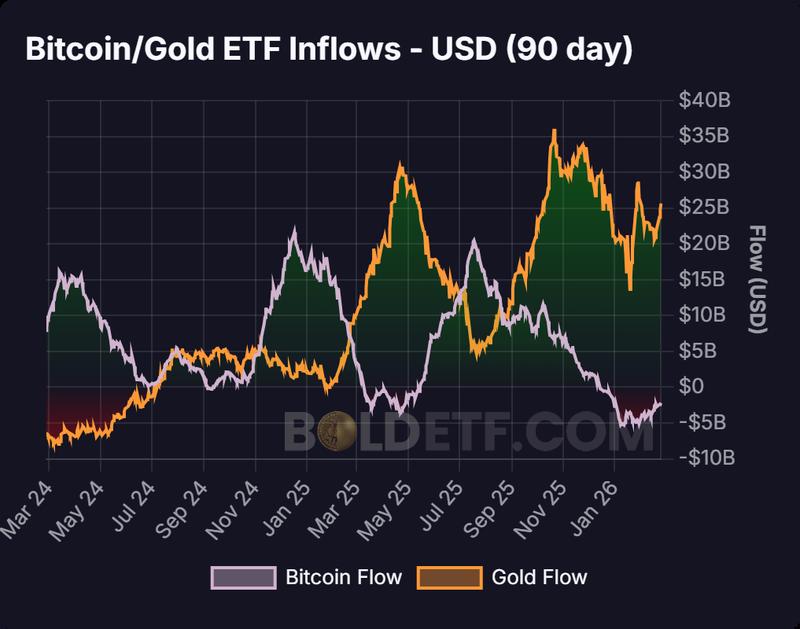
A negative reading in the rolling average indicates that capital withdrawals from ETFs exceed incoming investments across an extended timeframe. This dynamic diminishes purchasing momentum, undermines aggregate demand levels, and can create obstacles for upward price movements.
A reversal back into positive territory, accompanied by consistent inflow activity, could signal the resumption of institutional market involvement. Prolonged positive measurements typically correlate with enhanced price performance from BTC, together with improved market liquidity conditions.
Large holder accumulation patterns against long-term trends
Data from CryptoQuant monitors the annual change in aggregate whale positions alongside its 365-day moving average. Wallets containing between 1,000 BTC and 10,000 BTC accumulated over 200,000 BTC during the period spanning June through November 2023, as the price fluctuated within a $25,000 to $30,000 range.
Whenever the actual 1-year change rises above its 365-day average, it indicates whales are acquiring coins at a pace exceeding their historical trend. This crossover event in 2023 aligned with supply being absorbed during horizontal price action, which subsequently resulted in BTC's upward rally.
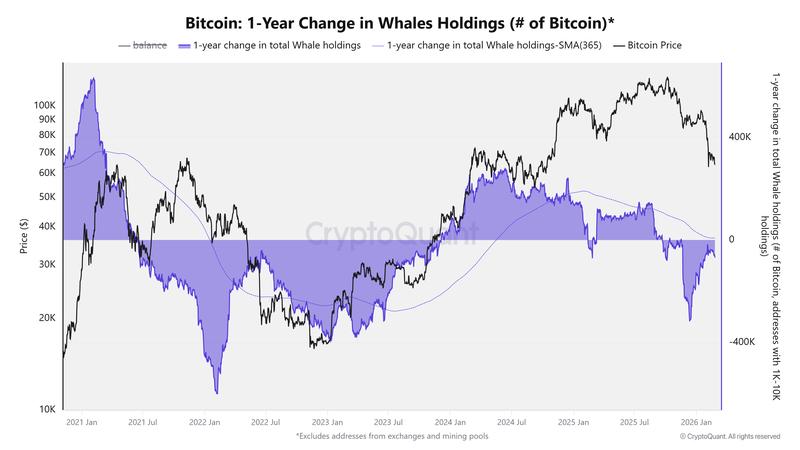
Therefore, a positive trend could emerge for BTC when the 1-year change consistently climbs above its moving average (365-SMA), indicating a return to substantial large-scale accumulation activity.
Network hash rate and mining infrastructure indicators
The 30-day mean hash rate for Bitcoin currently sits around 0.99 ZH/s following a peak of 1.10 ZH/s reached in November 2025. Both the hash rate and price have experienced declines throughout recent weeks.
The hash rate quantifies the total computational capacity dedicated to securing the blockchain network and represents miner capital allocation toward hardware infrastructure and energy resources. An increasing hash rate during periods of price consolidation suggests infrastructure growth occurring independently from near-term price appreciation.
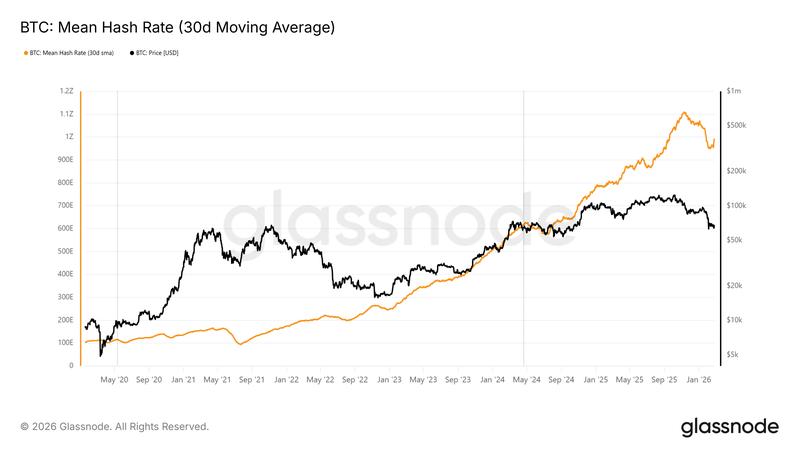
When the hash rate moves upward while prices remain range-bound, this reflects increased long-term dedication from mining participants. An ongoing divergence pattern, characterized by rising hash rate preceding price increases, may indicate growing optimism throughout the mining industry.
Similarly, the financial health of mining operations must demonstrate improvement. Stabilization in hash price metrics combined with decreased selling pressure from miners confirms that expanding computational capacity is supported by improved revenue dynamics rather than deteriorating profit margins.
Company Bitcoin treasury accumulation rate decelerates
A current analysis from bitcointreasuries.net indicated that corporate treasuries accumulated approximately 43,200 BTC throughout January 2025, with Strategy responsible for approximately 40,150 BTC of that total.
Examining a longer timeframe, the data demonstrates that corporate buying activity by Strategy has decelerated substantially since the latter part of 2024. Monthly acquisition volumes reached their highest point near 148,000 BTC during November 2024 and 87,000 BTC in July 2025.
Current monthly figures remain considerably lower, and the most recent 30-day increment represents merely a minor adjustment compared to the 1.13 million BTC currently controlled by publicly traded corporations.
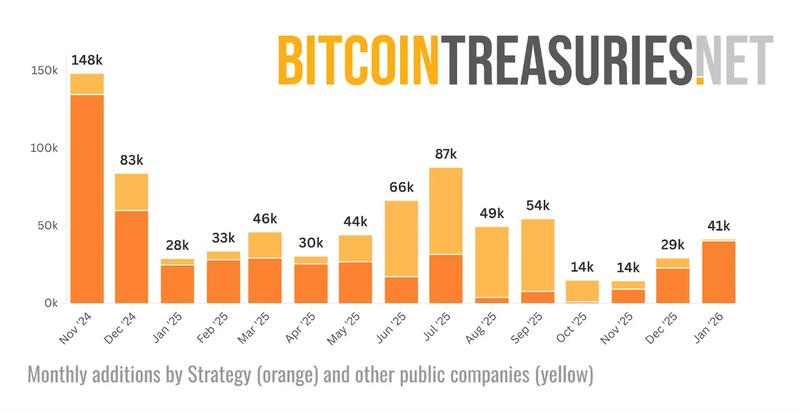
The most recent monthly net gain amounts to approximately 0.1% expansion when measured against aggregate public company Bitcoin holdings. This acquisition rate indicates consolidation rather than momentum building in corporate treasury expansion.
Regarding BTC price dynamics, more widespread and intensifying treasury inflows contribute to absorbing circulating supply with greater effectiveness. Decelerating growth rates, conversely, suggest corporations are predominantly preserving existing positions rather than generating fresh demand pressure.