Institutional DeFi adoption put to the test with Spark's dual lending platform launch
With the debut of Spark Prime and Spark Institutional Lending, the protocol seeks to bridge DeFi stablecoin infrastructure with institutional credit facilities and margin operations.

On Wednesday, Spark unveiled Spark Prime alongside Spark Institutional Lending as part of an initiative to direct a greater portion of its decentralized finance (DeFi) stablecoin reserves toward institutional credit facilities.
The decentralized asset allocator, whose primary contributor Phoenix Labs previously contributed to the development of MakerDAO's stablecoin framework and risk infrastructure, explained that the newly introduced suite is designed to enable borrowers to access stablecoin-based loans without needing to operate their own DeFi infrastructure.
Through Spark Prime, users gain access to margin-based lending capabilities and off-exchange settlement mechanisms driven by Spark's proprietary liquidity engine, whereas Spark Institutional Lending connects Spark-governed lending markets with approved custodians like Anchorage Digital, enabling clients to maintain their collateral within regulated custody environments.
Spark revealed that its initial launch partners for Spark Prime comprise Edge Capital, M1 and Hardcore Labs.
Sam MacPherson, co-founder and CEO of Phoenix Labs, shared with Cointelegraph that Institutional Lending had already secured approximately $150 million in commitments, with the infrastructure possessing capacity "to scale to billions over the coming months," whereas Spark Prime is launching with roughly $15 million and will expand at a more gradual pace as "key safety features" are implemented.
Spark leans on Coinbase and PayPal deals
Data from DeFi Llama indicates that Spark's total value locked (TVL) presently stands at $5.24 billion, a decrease from its peak of $9.2 billion recorded in Nov. 2025, positioning it as one of the more substantial DeFi money market platforms measured by assets under management.
For context, Aave presently dominates DeFi lending markets with $27 billion in TVL, whereas Maple registers $2.1 billion.
According to Spark, the protocol contributed over 80% of the USDC liquidity supporting Coinbase's Bitcoin-backed lending market operating on Morpho, facilitating approximately $500 million in loan expansion during the initial three-month period, and publicly available dashboards indicate that Spark-associated vaults have allocated more than $600 million to that particular market since its inception.
The PYUSD stablecoin initiative from PayPal has similarly utilized approximately $500 million in Spark-governed liquidity to expand onchain markets for PYUSD alongside other stablecoins.
DeFi's resilience and market backdrop
The platform debut also underscores the manner in which DeFi has demonstrated resilience compared to token valuations more broadly. Presently sitting at $96.52 billion, the aggregate DeFi TVL has contracted from approximately $120 billion at January 2026's conclusion, marking a 20% reduction throughout the recent cryptocurrency market downturn, when measured against the wider crypto marketplace.
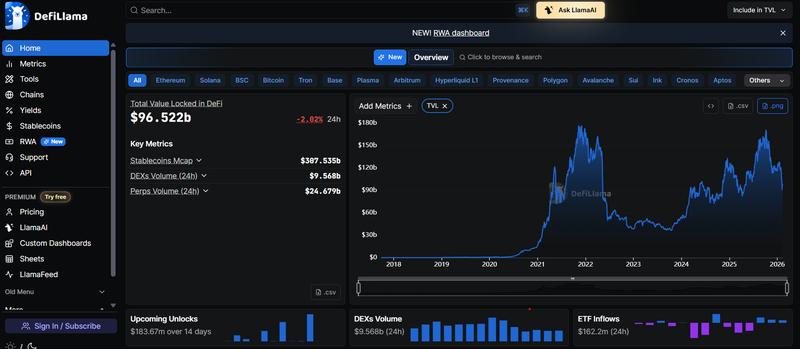
During the identical timeframe, Bitcoin (BTC) has declined from approximately $89,000 at Jan's close to around $66,800 at the time of writing on Feb. 11, representing a reduction of roughly 25%, whereas Ether (ETH) tumbled from about $3,000 at the conclusion of January to approximately $1,950, marking a decline of around 35%, based on data from Coingecko.
MacPherson contended that a key benefit of Spark's approach lies in the fact that "anyone can evaluate the full portfolio in real time," further noting that institutions possess the ability to underwrite its books against their own limits and exit "if the profile does not align with their risk controls."