Indiana Enacts Legislation Permitting Cryptocurrency in State Retirement Accounts
The newly passed House Bill 1042 features safeguards for cryptocurrency holders, preventing government bodies from implementing regulations that prohibit digital currency transactions, personal custody, or blockchain mining activities.

The state of Indiana is poised to permit specific retirement and savings programs to incorporate cryptocurrency investments while establishing enhanced legal safeguards for the digital currency sector through recently approved legislation.
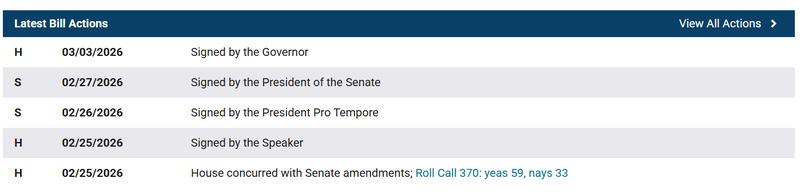
On Tuesday, Governor Mike Braun put his signature on House Bill 1042, making it official law following its approval by the state legislature last Thursday. The new law mandates that Indiana's state-managed public retirement and savings programs must provide self-directed brokerage accounts featuring no fewer than one cryptocurrency investment choice by the July 2027 deadline.
Based on the legislative text, this mandate encompasses the defined contribution plan for state legislators, the Hoosier START savings plan, select public employees' retirement funds, and designated retirement fund plans for educators.
An increasing number of institutions are embracing digital assets, with estimates from Bitbo indicating that more than 3.7 million Bitcoin (BTC) (valued at $258 billion) are currently in the possession of publicly traded corporations, private enterprises, exchange-traded funds and governmental entities.
Protections for crypto payments and mining
House Bill 1042 contains additional provisions designed to safeguard the interests of cryptocurrency users. According to the legislation, governmental agencies at the public level — with the exception of the Department of Financial Institutions — are prohibited from creating or implementing regulations that outlaw cryptocurrency payments, self-custody arrangements, or mining operations.
Additionally, the legislation provides clarification that applications and software protocols enabling non-custodial transfers do not require a money transmitter license to operate.
Municipal governments, including counties, cities, or townships, are similarly restricted from targeting cryptocurrency mining enterprises or individual home-based miners with unique regulatory requirements that aren't imposed on comparable businesses or operations within identical zoning classifications.
Sound pollution generated by crypto mining operations has sparked conflicts in other states across the country. Last year, Hood County, Texas residents made efforts to establish a new municipality as a means to control noise emissions from a cryptocurrency mining facility operating in their area.
Access to retirement funds a boon for crypto
On the national level, President Donald Trump's executive order from August titled "Democratizing Access to Alternative Assets for 401(k) Investors" instructed the SEC to increase accessibility to alternative investments like cryptocurrency within participant-controlled retirement plans.
Certain market analysts, including Tom Dunleavy, who serves as the head of venture at Varys Capital and previously worked as a senior analyst at Messari, have forecasted that even a modest 1% allocation toward crypto in 401(k) retirement accounts has the potential to generate $120 billion in fresh capital inflows.