Federal Reserve uncertainty and shutdown concerns dampen Bitcoin trader enthusiasm
Professional traders exercise caution as Bitcoin's climb toward $93,000 encounters resistance, with market attention concentrated on gold's unprecedented surge, Federal Reserve decisions, and US economic conditions.
Key takeaways:
- Market indicators reveal professional Bitcoin traders are exercising risk aversion while allocating additional resources to hedge against potential price declines.
- Despite gold reaching all-time record prices, Bitcoin continues to trade sideways as market participants demonstrate preference for conventional safe-haven assets.
Bitcoin (BTC) experienced a 1.5% increase after retesting the $86,000 threshold on Sunday, while market participants evaluate the potential consequences of a US federal government shutdown deadline set for Saturday. The upcoming week brings several critical market-moving events, including major technology company earnings releases and the US Federal Reserve's policy announcement scheduled for Wednesday.
Even as gold achieves unprecedented price levels, Bitcoin market participants maintain a cautious stance. Analysis of derivatives data points to widespread skepticism about additional upward momentum; interest in leveraged long positions remains subdued, and institutional traders are currently assigning elevated probabilities to downside price movements within options markets.
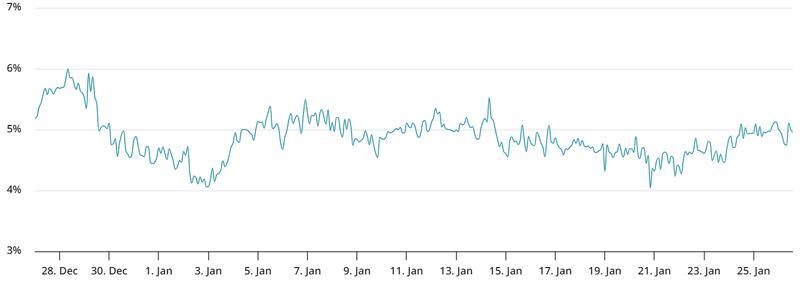
On Monday, the annualized premium for BTC futures (basis rate) registered at 5%. This figure scarcely provides adequate compensation for the extended settlement timeframes characteristic of these derivative instruments. Under normal circumstances, this metric climbs beyond 10% when traders adopt an optimistic outlook. In contrast, periods of bearish sentiment can push the rate into negative territory. On balance, market sentiment has persisted in neutral-to-bearish territory throughout the previous two weeks.
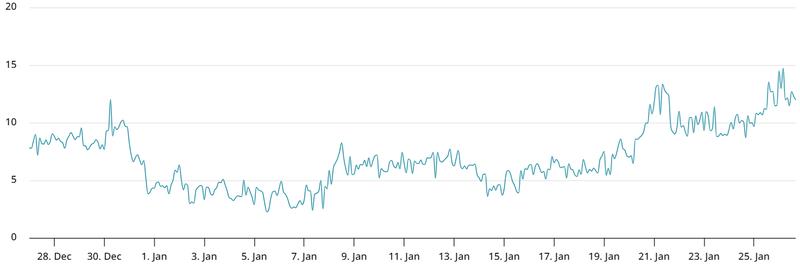
In parallel, the delta skew for BTC options hit 12% on Monday. This measurement signals that put (sell) options command a premium price, demonstrating significant hesitation among market participants to maintain exposure to downside risk. Under typical neutral market conditions, this metric generally oscillates within a range of -6% to +6%. The previous occasion this skew achieved comparable levels was Dec. 1, when Bitcoin crashed from $91,500 to $83,900 within mere hours.
Bitcoin lags as gold surges amid rising US debasement fears
Explaining Bitcoin's bearish price action exclusively through the lens of the US fiscal impasse appears paradoxical, particularly given the S&P 500's 0.6% gain on Monday. Simultaneously, gold rocketed to $5,100 for the first time ever. This price surge has prompted market analysts to question whether a "debasement trade" is gaining momentum. Although the depreciation of the US dollar relative to limited-supply assets represents a familiar narrative, it presently reflects a more comprehensive crisis of confidence that isn't necessarily generating immediate benefits for Bitcoin.
Market participants have grown progressively risk-conscious following the Federal Reserve Bank of New York's indication of a possible intervention to support the Japanese yen—an action unprecedented since 1998. Throughout the preceding twelve months, other principal fiat currencies have demonstrated superior performance compared to the US dollar, rendering US imports costlier and creating upward inflationary pressure. Should the Fed execute such an intervention, market participants might construe the action as an urgent measure designed to maintain global market stability.
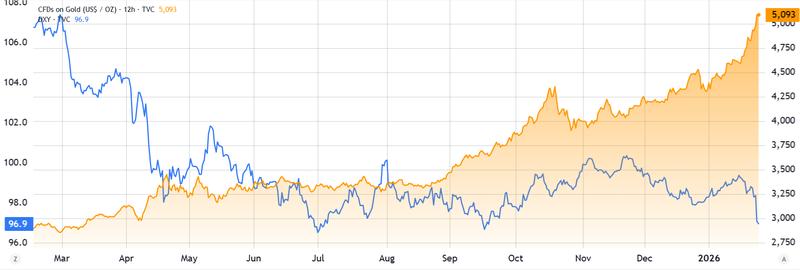
On Monday, the US Dollar Strength Index (DXY) fell beneath 97 for the initial time in four months as market participants pursued refuge in competing fiat currencies.
Notably, despite 5-year US Treasury yields exceeding comparable instruments in Europe and Japan at 3.8%, market participants continue preparing for elevated US inflation. Evidence increasingly suggests that the US will embrace a more accommodative monetary stance, especially given that Fed Chair Jerome Powell's term expires in April.
US President Donald Trump has explicitly communicated that Powell's replacement must prioritize reducing Fed funds rates. This strategy would offer enhanced fiscal flexibility for the US Treasury through diminished interest payment obligations. Although more expansionary monetary policy generally benefits equity markets, it doesn't necessarily establish an immediate or straightforward catalyst for Bitcoin investment.
Should quarterly earnings from leading technology corporations exceed analyst expectations this week, there could be even diminished motivation for market participants to shift capital into alternative scarce assets. In the final analysis, Bitcoin's journey to recapture the $93,000 threshold depends on institutional traders restoring their conviction. This confidence restoration could require more time than anticipated as macroeconomic transitions and the corporate earnings reporting period command center stage throughout this week.