Extended Period of Negative Bitcoin Funding Rates Hints at 'Excessive' Short Positions: Is a Trend Shift Imminent?
For several consecutive days, Bitcoin's daily funding rate has maintained deeply negative levels, indicating substantial short positioning among traders, though historical patterns point to the possibility of an impending bear squeeze.
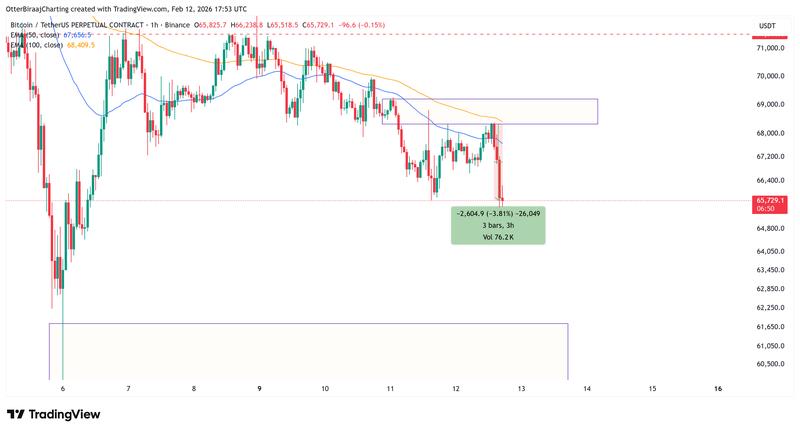
On Thursday, Bitcoin (BTC) established a fresh weekly bottom at the $65,500 mark, with the cryptocurrency maintaining its downward trajectory throughout the subsequent four-day period. Data from derivatives markets also reveal that market participants have built up significant bearish exposure.
Market experts suggested that this particular configuration could potentially trigger a substantial upward price movement that would compel those holding short positions to liquidate their trades, though additional market indicators suggest the path forward may prove more complex.
Key takeaways:
- For the first time since March 2023 and November 2022, the seven-day average funding rate for Bitcoin has shifted to strongly negative territory.
- Data tracking Bitcoin liquidity and stablecoin flows indicate fresh capital withdrawals, diminishing the likelihood of a prolonged squeeze event.
Bitcoin funding maintains negative territory amid growing short interest
Since February commenced, Bitcoin's daily funding rate has persisted in deeply negative zones, representing its most bearish reading since May 2023. The seven-day simple moving average has crossed into negative territory for the first time in approximately twelve months.
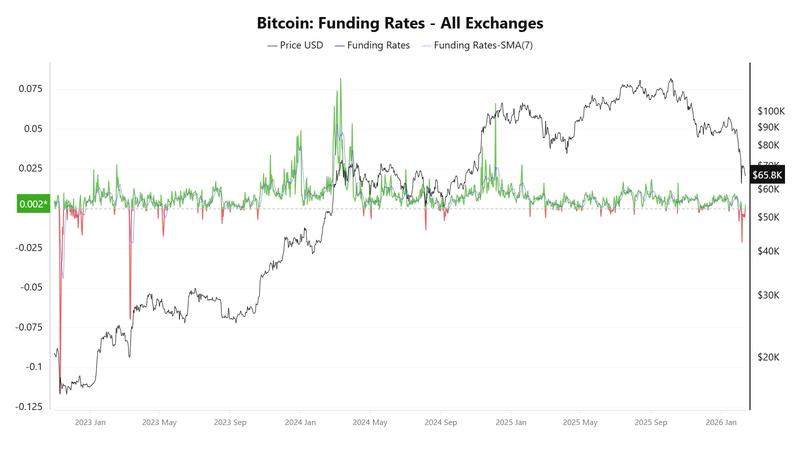
The funding rate represents a periodic settlement between participants in futures markets. A negative reading indicates that traders holding short positions are paying those holding long positions, demonstrating that bearish sentiment has become concentrated, and the opposite occurs when positive.
According to crypto analyst Leo Ruga, the present "red funding rate for days" indicates that the bearish or short trade may be getting overcrowded. Ruga added,
"This is the kind of negative funding that typically appears during bottoming phases. Not because shorts are wrong, but because extended negative funding often marks exhaustion of selling pressure."
In a similar vein, market analyst Pelin Ay pointed out that the funding rate recently fell to approximately -0.02 last Friday, accompanied by pronounced negative spikes. Ay added that when steep price drops align with negative funding, it can create conditions for a short squeeze, especially if $58,000 maintains its position as the local support.
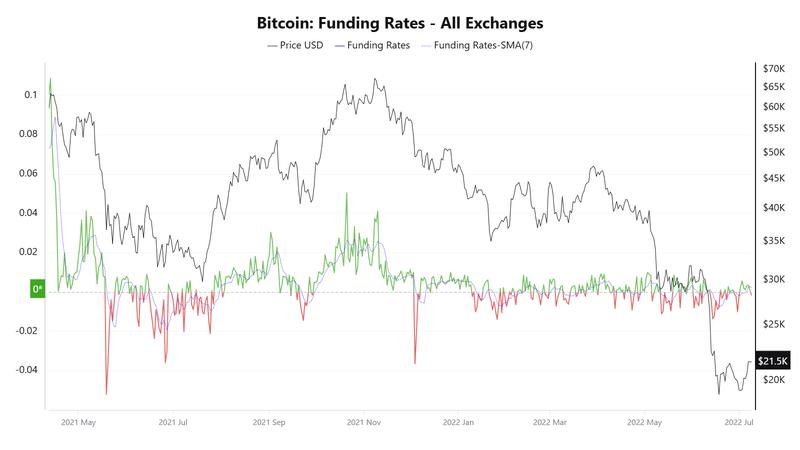
The previous instance when Bitcoin's daily funding rate remained deeply negative for 10 to 20 days following a bullish phase occurred in May 2021 and January 2022. In May 2021, BTC underwent correction for almost two months before surging to new highs. In January 2022, the negative stretch preceded a broader bearish cycle. Thus, an extended negative funding has not produced an immediate reversal in the past.
On-chain metrics reinforce a measured perspective. Bitcoin researcher analyst Axel Adler Jr. observed that the SSR oscillator, which measures Bitcoin's strength relative to stablecoins, has predominantly remained in the negative territory since August 2025.
A temporary shift into positive territory in mid-January (+0.057) aligned with a rally above $95,000, but the oscillator has subsequently declined to -0.15 as the price retreated toward $67,000.
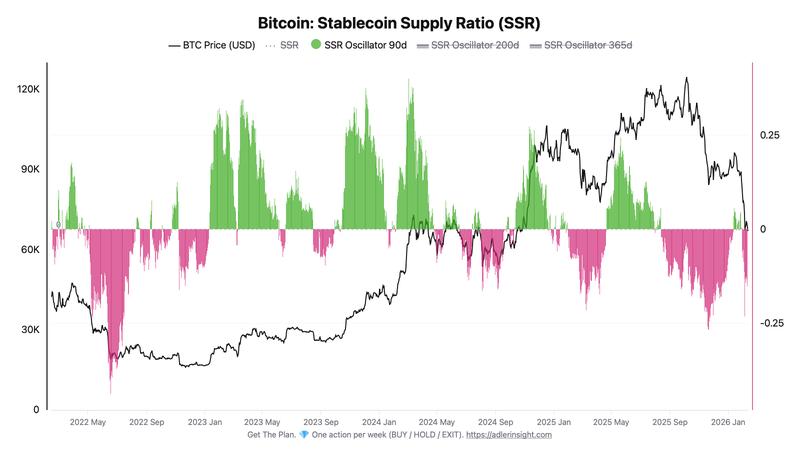
Movements in stablecoin liquidity present a comparable narrative. The 30-day change in USDT market cap shifted to positive in early January (+$1.4 billion), but it has subsequently reversed to -$2.87 billion, indicating a period of capital outflows.
Unless liquidity patterns and the SSR oscillator shift to sustainably positive, Adler Jr. said that the BTC market remains in a "risk-off" phase.
This article does not contain investment advice or recommendations. Every investment and trading move involves risk, and readers should conduct their own research when making a decision. While we strive to provide accurate and timely information, Cointelegraph does not guarantee the accuracy, completeness, or reliability of any information in this article. This article may contain forward-looking statements that are subject to risks and uncertainties. Cointelegraph will not be liable for any loss or damage arising from your reliance on this information.