ETF Inflows End 5-Week Drought as Bitcoin Market Manipulation Allegations Draw Skepticism: Finance Redefined
Market experts challenge allegations of systematic Jane Street Bitcoin selloffs while spot Bitcoin ETFs record three consecutive days of positive flows and DeFi discussion pivots toward sustainable revenue models.

During the past week, allegations of a systematic "10 a.m. Bitcoin dump" attributed to quantitative trading firm Jane Street circulated widely across social media following a lawsuit filed by the court-appointed administrator of Terraform Labs, though industry analysts maintain that available data fails to substantiate claims of a persistent, firm-driven price suppression campaign.
These allegations gained momentum just one day following the filing of a lawsuit against Jane Street by Terraform Labs' administrator, which included accusations of insider trading activities that allegedly exacerbated the downfall of Terra's algorithmic stablecoin network in May 2022.
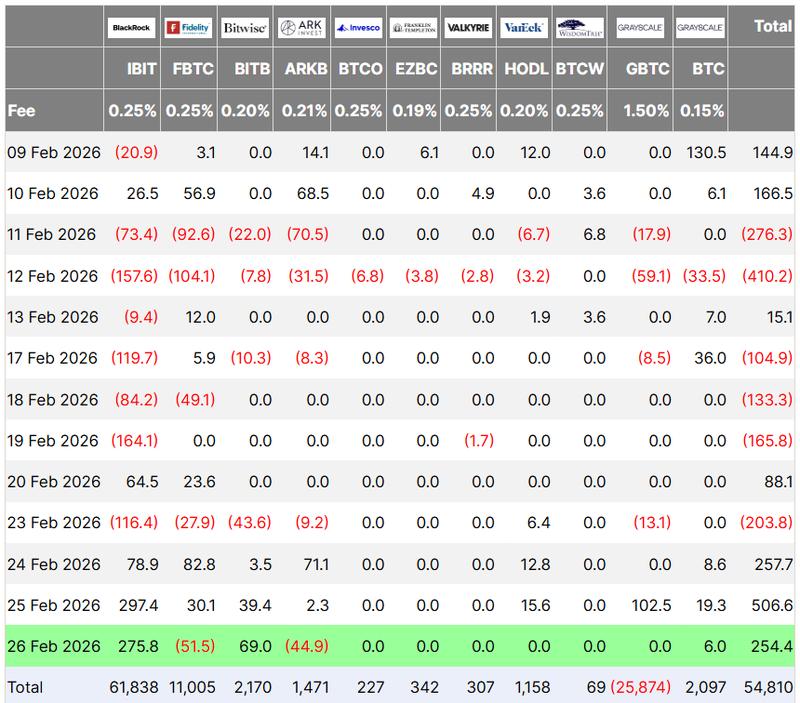
In other market developments, appetite for spot Bitcoin exchange-traded funds made a comeback following five straight weeks of net capital withdrawals. Bitcoin ETFs listed in the United States attracted more than $1 billion across three back-to-back days during this week, registering $254 million in combined inflows on Thursday, based on information from Farside Investors data.
Corporate holdings of Ether came under significant strain as well. Bitmine Immersion Technologies, the company holding the largest corporate Ether (ETH) position, reportedly confronts an $8.8 billion unrealized loss on its token holdings as the broader market downturn persists.
Market experts dismiss Jane Street "10 a.m. dump" allegations, assert Bitcoin resists easy manipulation
Digital asset investors pointed fingers at quantitative trading firm Jane Street for allegedly driving down Bitcoin's valuation through a daily, automated liquidation occurring at the opening of US markets, however industry experts and available evidence indicate the pattern lacks consistency, and no individual entity possesses the capacity to force Bitcoin into an extended bearish cycle.
These allegations spread rapidly online one day following the lawsuit filed against Jane Street by the court-appointed administrator for Terraform Labs, which contained insider trading accusations connected to trades that allegedly intensified the destruction of Terra's algorithmic stablecoin infrastructure in May 2022.
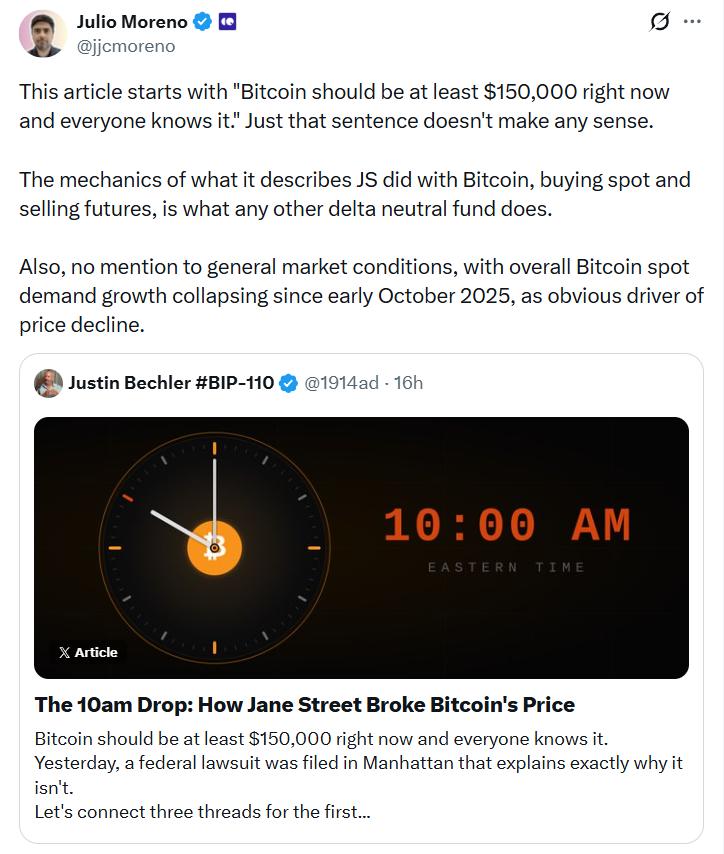
Multiple market observers, including cryptocurrency commentator Justin Bechler, have contended that Jane Street's position in BlackRock's iShares Bitcoin Trust exchange-traded fund (ETF), identified as IBIT, might conceal a net bearish Bitcoin stance through hedging mechanisms that remain absent from publicly available regulatory documents. Bechler maintained that Jane Street executed synchronized algorithmic Bitcoin sales at 10 a.m. EST each trading day, influencing the Bitcoin (BTC) valuation to acquire the ETF at reduced prices.
When Jane Street reports holding $790 million in IBIT shares, the filing tells you nothing about whether those shares are hedged by puts, offset by short futures, or wrapped in a collar that makes the firm's net Bitcoin exposure zero or even negative. The actual position could be a massive short that looks like a long because the offsetting half of the trade is invisible under current disclosure rules.
Justin Bechler
Julio Moreno, who serves as head of research at CryptoQuant, warned that the trading behavior Bechler outlined is not exclusive to a single firm. He explained that purchasing spot market exposure while simultaneously selling futures contracts represents a standard strategy for delta-neutral investment vehicles seeking to exploit pricing differences rather than pursuing directional market exposure.
The most recent 13-F filing from Jane Street additionally revealed positions in Strategy, along with substantial stakes in Bitcoin mining operations including Bitfarms, Cipher Mining and Hut 8.
Vitalik offloads 17,000 ETH within one month following $45 million privacy allocation announcement
Vitalik Buterin, co-creator of Ethereum, has decreased his Ether holdings by approximately 17,000 ETH during a single month following his disclosure of intentions to allocate $45 million in token value toward privacy-focused initiatives.
Wallets belonging to Buterin that are monitored by Arkham contained roughly 241,000 Ether (ETH) during early February, prior to multiple outgoing transfers that brought the aggregate balance down to 224,000 ETH by Tuesday.
This decline occurred alongside persistent selling activity by Buterin, which included approximately 2,961 Ether valued at $6.6 million throughout a three-day window earlier in the month. Blockchain analysts documented that this activity intensified in recent days as he liquidated $7 million in token value across three days.
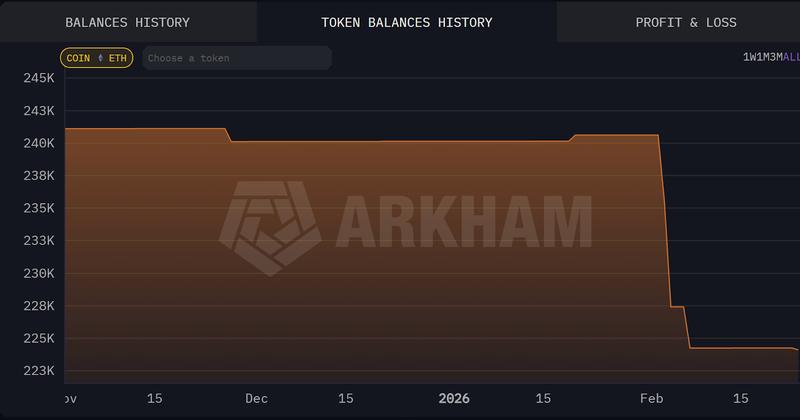
Information from Arkham Intelligence reveals the ETH liquidations were processed through decentralized exchange (DEX) aggregation service CoW Protocol utilizing many smaller exchange transactions rather than a single large trade, an approach commonly used to reduce adverse market impact.
Bitmine unrealized losses approach $8.8 billion as Ether downturn challenges cyclical investment theory
Corporate treasuries holding Ether face mounting strain as the cryptocurrency market decline intensifies, with market analysts cautioning the sector is nearing a critical juncture for Ether's long-term investment viability.
Bitmine Immersion Technologies, ranked among the largest institutional holders of Ether (ETH), carries a substantial unrealized deficit as ETH exchanges considerably beneath the firm's average purchase price, based on third-party monitoring service Bitminetracker. Certain calculations place Bitmine's paper deficit in the vicinity of $8.8 billion following Ether's depreciation throughout recent months.
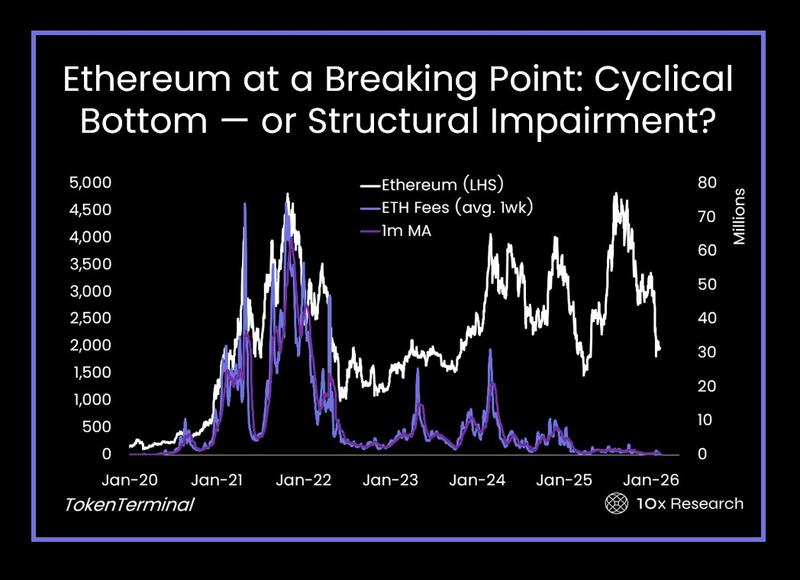
The price of ETH has declined 60% over the preceding six-month period, falling substantially below Bitmine's average acquisition cost of $3,843 per token, according to Bitminetracker information.
Digital asset research firm 10x Research stated Monday that Ether currently trades near pricing and cost-basis thresholds that challenge whether the cryptocurrency is merely experiencing a cyclical correction or transitioning into an era of more profound, fundamental deterioration.
Investors must therefore assess carefully whether the asset is simply in a cyclical downturn or entering a phase of deeper structural impairment.
Bitmine persists in purchasing ETH notwithstanding the growing unrealized deficits. During the previous week, Bitmine obtained 45,749 Ether at an average combined cost basis of $1,992 per ETH, demonstrating conviction from the globe's largest Ether treasury organization.
Major Wall Street institutions continue to sustain their positions in Bitmine notwithstanding the market contraction.
The leading 11 shareholders of Bitmine, encompassing Morgan Stanley, Ark Investment Management and investment manager BlackRock, have collectively expanded their holdings in the treasury enterprise throughout the fourth quarter of 2025.
The stock price of Bitmine has decreased by roughly 59% during the past six-month span and exchanged at $19.68 during pre-market trading on Monday, according to information from Google Finance.
Aave crosses $1 trillion lending volume milestone during institutional growth phase
Decentralized finance infrastructure Aave has exceeded $1 trillion in total lending volume, establishing a historic milestone in the DeFi sector.
A decade ago, DeFi and Aave didn't exist. They were just ideas. Today, Aave stands as the backbone of onchain lending, powering a new financial system that is open, global, and unstoppable.
Stani Kulechov, Aave Labs CEO
This achievement represented another advancement toward Aave's ambition of establishing itself as the "largest, most efficient liquidity network in the world," Kulechov continued. "One that builders, banks, and fintechs plug into by default, fundamentally improving liquidity and cost structures across global finance."

Last August, Aave Labs introduced Aave Horizon, an innovative lending platform on Ethereum, designed exclusively for conventional finance institutions and additional institutional market participants to access stablecoin borrowing against real-world asset collateral.
VanEck, WisdomTree and Securitize numbered among the initial participants to utilize Aave's enterprise-focused product.
On Feb. 15, Kulechov suggested DeFi lending stands to gain from tokenizing "abundance assets," including solar energy, battery storage systems for energy retention and robotic automation for labor productivity. He anticipates these assets will achieve a combined valuation of $50 trillion by 2050.
Kulechov initially deployed Aave as ETHLend in November 2017 prior to renaming it to Aave in September 2018. The protocol currently safeguards more than $27.2 billion in total value locked, allowing participants to generate returns on deposited assets and access immediate borrowing utilizing cryptocurrency as security.
Aave surpasses multiple prominent DeFi lending platforms in TVL, encompassing Morpho, JustLend, SparkLend, Maple, Kamin Lend and Compound Finance, all of which maintain more than $1 billion in total value locked.
Aave has produced more than $83.3 million in transaction fees during the most recent 30-day period, representing almost four times the amount of its nearest rival, Morpho.
Curve creator declares DeFi must abandon token emissions in favor of genuine revenue
Decentralized finance (DeFi) can no longer depend on inflationary token reward mechanisms to maintain expansion, according to Michael Egorov, creator of Curve Finance.
During a conversation with Cointelegraph, Egorov stated that protocols need to produce authentic revenue streams instead of relying on emissions to draw in liquidity.
Your yield should come from revenues, not from tokens. You need real revenues flowing. If a token is not doing something, maybe it's better for you to not do token at all.
Michael Egorov, Curve Finance founder
Egorov drew a comparison between the present landscape and the "DeFi summer" of 2020, during which triple-digit and occasionally 1,000% annual percentage yields attracted capital toward emerging protocols. He noted that during that period, speculative valuations elevated token prices and bootstrapped total value locked (TVL) for various platforms.
Right now, news doesn't change prices of tokens anymore.
Michael Egorov
Egorov contended that market participants have "re-evaluated the risks."
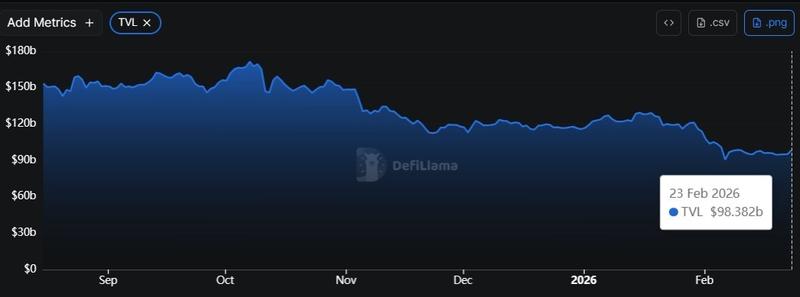
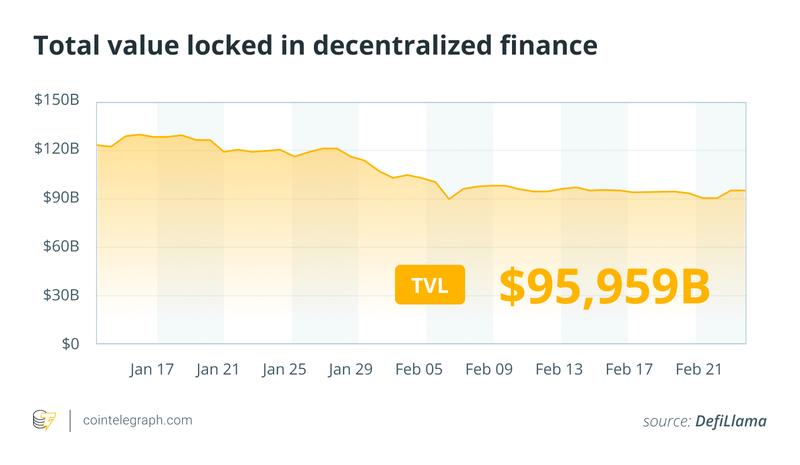
His statements arrived as DeFi's TVL experienced approximately a 38% decline throughout the past six-month timeframe, per DefiLlama data. Information from the analytics service indicates TVL decreased from $158 billion on Aug. 23, 2025, to roughly $98 billion as of Monday.
DeFi sector summary
Based on information from Cointelegraph Markets Pro and TradingView, the majority of the 100 largest digital currencies by market capitalization concluded the week with positive performance.
The Pippin (PIPPIN) token increased 55% as the week's strongest performer within the top 100, trailed by the Decred (DCR) token, which climbed more than 44% throughout the previous week.