Cryptocurrency Scams Powered by AI Surge 500% as Fraud Operations Turn Corporate
According to TRM Labs, fraudsters funneled $35 billion in cryptocurrency to scam wallets throughout last year, utilizing artificial intelligence and corporate-style efficiency to expand their criminal enterprises.

Scammers deployed large language models at a rate five times higher in 2025 compared to previous periods, TRM Labs reports, as criminals harnessed this technology to expand their reach, enhance the credibility of their schemes and execute operations on an unprecedented scale.
This development coincides with cryptocurrency worth $35 billion being transferred to fraudulent addresses throughout 2025, representing a minor decline from the $38 billion recorded in the year prior, according to TRM Labs' 2026 cryptocurrency crime analysis released on Wednesday.
"Large language models (LLMs) enable scams to cross language and cultural contexts with less friction, while AI-generated images, voice cloning, and deepfake videos reduce the cost of creating convincing personas," the firm said.
In March last year, at least three crypto founders reported foiling an attempt from alleged North Korean hackers to steal sensitive data through fake Zoom calls that used deepfakes.
"These capabilities are expanding impersonation-style scams across messaging platforms, recruitment campaigns, and investment fraud — and they increase the likelihood that victims can be deceived even when aware of scam warnings," TRM Labs said.

Fraudsters are beginning to merge different scam methodologies
An additional development observed last year involved the merging of various scam strategies, TRM Labs noted, with cryptocurrency fraudsters progressively adopting multidimensional approaches to deceive their targets.
TRM Labs said this could start with a romance scam to build trust, then transition to offering fake investments once trust is established, and end with a tax scam that demands payment for non-existent tax and administrative fees.
"A defining trend in the current state of crypto fraud is the convergence of distinct scam typologies. Victim journeys increasingly span multiple phases of deception, combining elements of romance scams, investment fraud, and advance fee schemes," the firm said.
"Although social engineering remains a key component of fraud campaigns, it is now reinforced by technical and organizational innovations that make fraud more scalable and harder to detect."
Fraudulent networks functioning with corporate-style organization
The multi-tiered strategy employed by criminals demonstrates an evolution toward increasingly complex fraud operations and a more corporate operational model, utilizing streamlined organizational structures, role specialization, and uniform procedural guides to identify and manipulate victims on a massive scale, according to the report.
Behind the scenes, there is also a growing ecosystem of illicit service providers offering support with tools, techniques, and recruitment pipelines that resemble legitimate hiring processes.
"Some offer AI-as-a-service tools to automate outreach and engagement, while others sell phishing kits or provide access to breached data. These services lower the barrier to entry for fraud actors and enable them to replicate scams across geographies," TRM Labs said.
Illegal transaction volume climbs 146% from 2024
According to TRM Labs' calculations, cryptocurrency wallets associated with illegal activities accumulated approximately $158 billion in value throughout last year, representing a roughly 146% surge from 2024's $64 billion total, propelled by expanded sanctions targeting nations such as Russia and technological improvements in tracking capabilities, uncovering greater levels of activity.
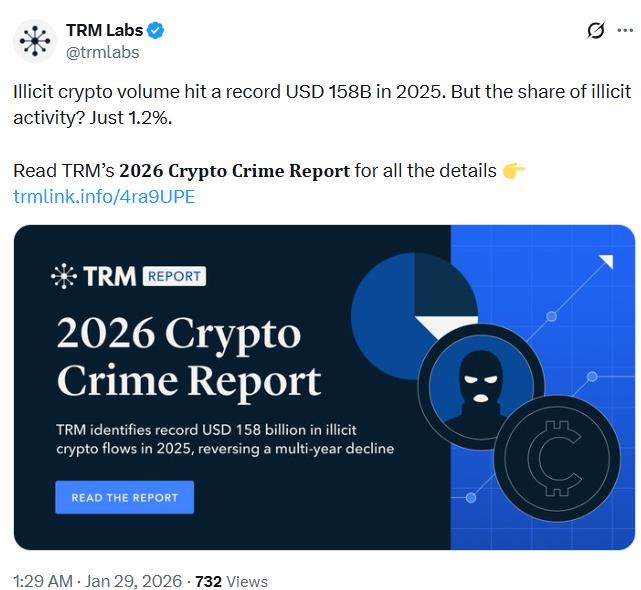
However, despite the increase in illicit volume, its proportion of overall crypto volume fell in 2025, from 1.3% in 2024 to 1.2% in 2025.