BTC Records $2.3B in Realized Losses Marking Largest Selloff Since 2021: Expert
The leading cryptocurrency has experienced unprecedented realized losses representing one of its most significant capitulation episodes ever, with short-term investors dumping holdings at major losses during the downturn.

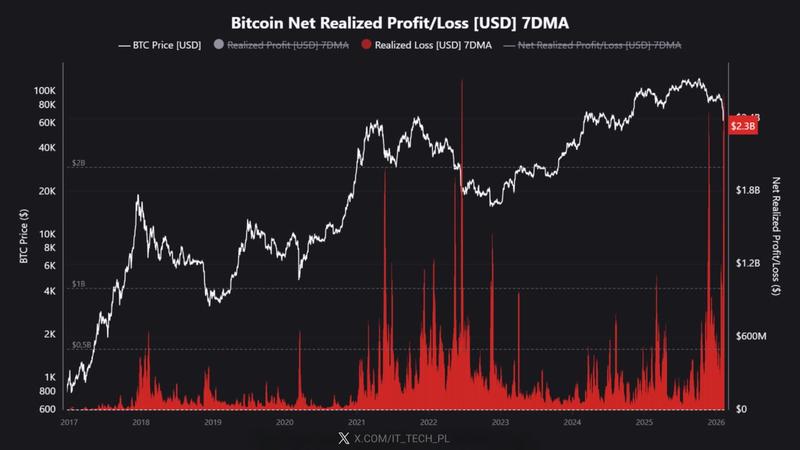
The flagship cryptocurrency has registered realized losses totaling $2.3 billion in what market observers are describing as among the most significant capitulation episodes on record, comparable to the devastating selloff witnessed in 2021.
According to analyst IT Tech in a Thursday analysis posted on CryptoQuant, Bitcoin's (BTC) seven-day rolling average of realized net losses reached the $2.3 billion mark, describing it as "one of the largest capitulation events in BTC history, rivaling the 2021 crash, 2022 Luna/FTX collapse, and mid-2024 correction."
IT Tech further emphasized that "This puts us in the top 3-5 loss events ever recorded," noting that "Only a handful of moments in Bitcoin's history have seen this level of capitulation."
The world's premier cryptocurrency has plummeted approximately 50% from its record peak exceeding $126,000 reached in October, currently changing hands near $66,600 after recovering from a Feb. 6 bottom of $60,000.
Prolonged downturn may be ahead
According to IT Tech, while "extreme loss spikes like this triggered rebounds" in the past, and despite Bitcoin's temporary surge above $70,000 on Tuesday, the analyst cautioned that "this could still be the beginning of a deep and slow bleed-out. Relief rallies happen even in prolonged bear markets."
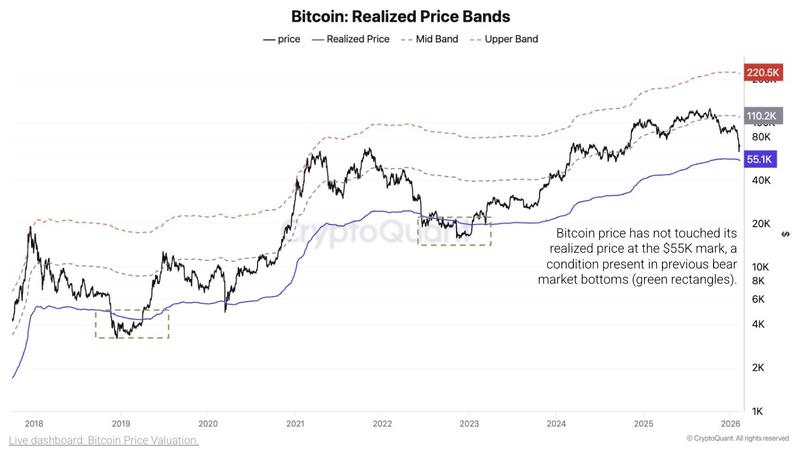
In a Thursday post on X, CryptoQuant highlighted that Bitcoin's realized price stands at $55,000, a level "historically tied to bear market bottoms."
The firm noted that "Past cycles saw BTC trade 24% to 30% below this level before stabilizing," adding that "When BTC reaches this area, it usually moves sideways before recovering."
Bottom formation may take longer
In comments provided to Cointelegraph, Nick Ruck, who serves as director of LVRG Research, explained that the latest capitulation episode "reflects intense short-term holder panic and washout amid broader macro pressures and a shift into bear market territory."
Ruck went on to state that "While this level of oversold conditions historically precedes recovery phases, reaching the full bottom may still require additional time and signals from metrics like sustained institutional buying or miner stabilization."
According to Ruck, potential support could materialize within the $40,000 to $60,000 range, "depending on evolving market dynamics," aligning with forecasts from other market analysts.