Blockchain-based stock tokens are 'unavoidable' and could prevent market halts: CEO of Robinhood
According to Robinhood's CEO Vlad Tenev, the current one-day settlement period for stock transactions remains excessively lengthy, an issue that tokenized equities could potentially address.
According to Vlad Tenev, CEO of Robinhood, the implementation of tokenized equities has the potential to eliminate trading halts that regularly plague conventional exchanges, including the infamous GameStop meme stock suspension several years back that prevented traders from accessing the market.
In a Wednesday post on X, Tenev characterized the 2021 GameStop trading halt as "one of the strangest and most visible equity market failures in recent history," attributing it to complex regulations tied to the two-day settlement timeline that was standard for stock transactions during that period.
"What happens when you combine slow, outdated financial infrastructure with unprecedented trading volume and volatility in a small number of stocks? Massive deposit requirements, trading restrictions, and millions of unhappy customers," he added.
Numerous trading platforms, including the New York Stock Exchange (NYSE), are currently developing tokenized stock systems.
According to Tenev, such platforms could be essential for accomplishing instant settlement, which "has proven elusive in the traditional equities markets, with a slew of legacy stakeholders to manage."
"As the advantages become increasingly clear, I believe it is inevitable that the US embraces this technology," he added.
Tokenization to ease pressure on financial system: Tenev
Tenev observed that settlement periods for US stocks have been reduced to one day following the freeze incident, yet he contended that this timeframe is "still far too long" given that settlement durations can extend to three days when trades are executed on Friday, or as long as four days during extended holiday weekends.
"That's where tokenization comes in," he added. "Moving equities on-chain in tokenized form allows them to benefit from the real-time settlement properties of blockchain technology."
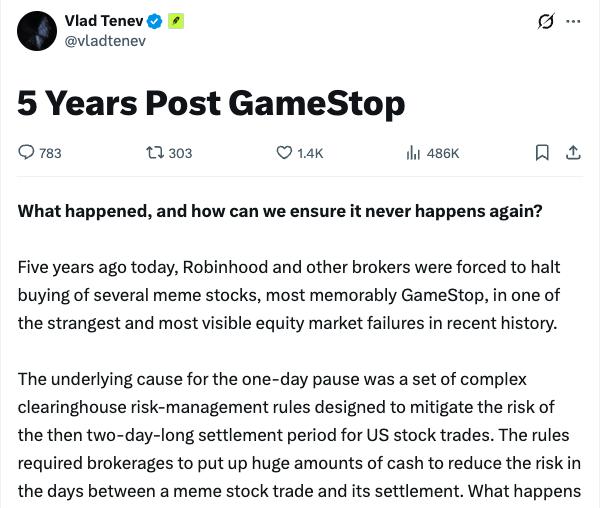
A primary factor behind Robinhood's decision to halt meme stock trading in 2021 stemmed from insufficient cash reserves to enable settlement, given that regulations mandated the company to "put up huge amounts of cash" to mitigate risk during the interval between when stocks are traded and when transactions are finalized, Tenev clarified.
The CEO revealed that the firm secured $3 billion in capital within a two-day span to bolster its financial reserves, though during this period, "retail investors who wanted to buy GameStop were understandably livid."
Leveraging tokenization technology to eliminate the settlement window would result in "much less risk to the system and less pressure on both clearinghouses and brokerages," according to Tenev.
Temporary trading suspensions represent a routine phenomenon in conventional financial markets, with the Nasdaq and NYSE collectively implementing over 100 temporary trading pauses across different securities on Wednesday alone, predominantly in five-minute intervals designed to stabilize market volatility.
Regulatory clarity to help adoption
According to Tenev, the present moment represents a "timely opportunity" for establishing regulatory frameworks, particularly as the Securities and Exchange Commission has shown openness toward experimenting with tokenized securities and Congress is working to enact cryptocurrency regulations, known as the CLARITY Act.
"By working with the SEC and pushing for sensible US equity tokenization guidelines via CLARITY, together we can ensure that trading restrictions like we saw in 2021 never have to happen again," he added.