Bitcoin's Neutral Money Narrative Gains Momentum After Dalio's Global Order Collapse Warning
Bridgewater's Ray Dalio declares the rules-based international system has collapsed, reigniting discussions about currency devaluation, US dollar vulnerabilities, and the need for permissionless, neutral financial infrastructure in global markets.

The founder of Bridgewater Associates, Ray Dalio, has issued a stark warning declaring that the international order established after World War II has "officially broken down," characterizing the current global trajectory as entering a "law of the jungle" phase where strength and power dictate results rather than international rules and norms. Cryptocurrency proponents are seizing this declaration to reinforce arguments for financial assets engineered to function independently of governmental oversight.
Through his most recent analysis published on X addressing both domestic and international instability, Dalio articulated how major global powers find themselves trapped in an ongoing "prisoner's dilemma." Nations face a binary choice: intensify their positions or project vulnerability across multiple domains including trade relations, technological competition, capital movement and, with growing frequency, military confrontations. This dynamic makes what Dalio characterizes as "stupid wars" dangerously simple to initiate.
According to Dalio's assessment, this international chaos inevitably intersects with domestic pressures. During periods of economic pressure combined with significant wealth inequality, governments consistently resort to elevated taxation alongside "big increases in the supply of money" that diminish the value of existing holdings, choosing this path over declaring outright defaults.
This particular convergence of factors creates precisely the conditions under which politically neutral assets such as Bitcoin (BTC) and gold have historically demonstrated strong performance. The value proposition articulated by cryptocurrency supporters is clear and direct: when governments increasingly deploy sanctions, freeze assets and expand monetary supply, market participants will more seriously evaluate assets capable of being stored and moved without dependence on banking institutions or state-controlled payment infrastructure.
Liquidity data fuels hard assets
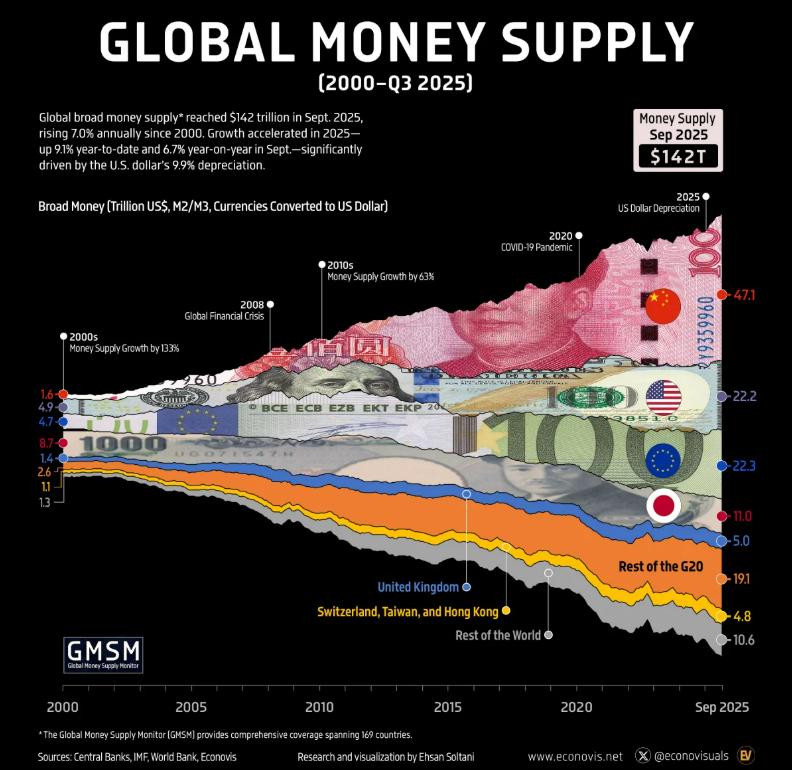
Research compiled by Econovis revealed that worldwide broad money expanded from $26 trillion in 2000 to a projected $142 trillion in 2025.
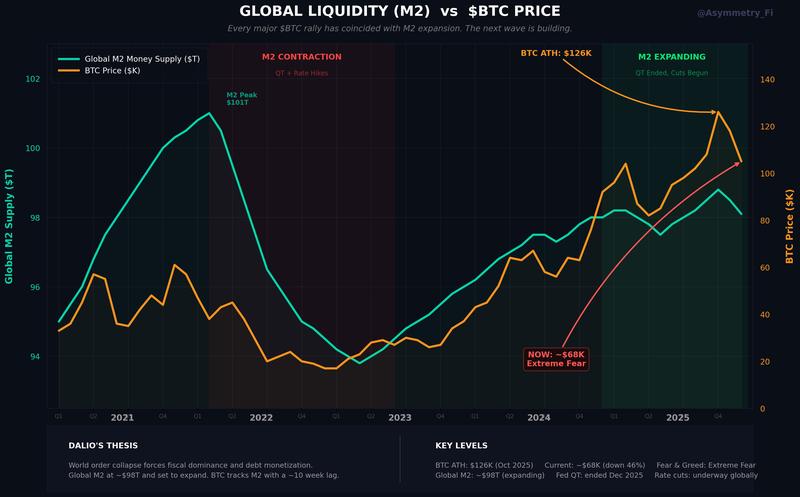
Former fund manager Asymmetry observes that each significant BTC price surge has aligned with M2 monetary expansion, noting that "the next wave is building."
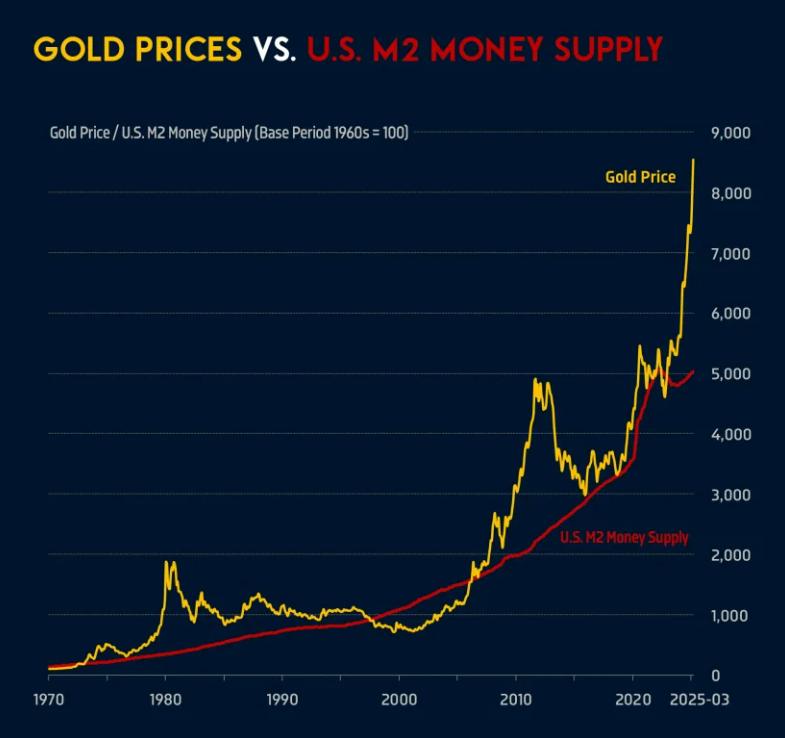
The price of gold has similarly moved in correlation with the US M2 money supply over time, demonstrating the precious metal's longstanding role as a conventional protection against monetary base expansion.
A bull case for neutral money
Within Dalio's analytical framework, he highlights how nation-states routinely deploy asset freezes, prohibitions on capital market access, and trade embargoes as conventional tools of statecraft. This pattern reveals the extent to which conventional savings vehicles and payment systems remain vulnerable to political decision-making and geographical jurisdiction concerns, bringing arguments for politically neutral, globally accessible currency into sharp focus.
Hunter Horsley, CEO of Bitwise, distilled the cryptocurrency sector's reaction in a brief remark, stating, "Is anyone working on global, permissionless, apolitical monetary assets and financial rails?? Could be important."
Asymmetry echoed similar sentiments from an investment allocation perspective, contending that the scenario Dalio outlines—a disintegrating international system combined with what macroeconomic researchers like Lyn Alden or Luke Gromen identify as fiscal dominance, a condition where government financing requirements effectively control central bank decision-making—represents one of the "most structurally bullish backdrop for hard assets in 80 years."
Nevertheless, Dalio's cautionary analysis does not constitute a specific prediction for Bitcoin, and the investment rationale for cryptocurrency continues to be influenced by numerous variables, including prevailing interest rates, regulatory frameworks, market liquidity conditions and investor risk tolerance. What his recent observations do contribute is a well-defined macroeconomic storyline that numerous cryptocurrency market participants are leveraging to suggest that appetite for "neutral money" may expand as global fragmentation accelerates.