Bank Negara Malaysia Launches Regulatory Sandbox for Digital Currency and Asset Tokenization
New regulatory testing frameworks will examine institutional wholesale payments and practical applications, alongside the creation of stablecoins and tokenized deposits from financial institutions.

Malaysia's central banking authority, Bank Negara Malaysia (BNM), announced on Wednesday the launch of three regulatory sandbox initiatives under its Digital Asset Innovation Hub (DAIH) focused on the research and advancement of stablecoins alongside tokenized deposits from banking institutions.
The central bank's programs are focused on utilizing stablecoins backed by the ringgit, Malaysia's national fiat currency, for international settlement transactions and the advancement of tokenized real-world assets (RWAs), as detailed in the official announcement.
These pilot initiatives additionally seek to evaluate tokenized deposits from financial institutions, with the entire research endeavor potentially informing the creation of a wholesale central bank digital currency (CBDC), representing onchain fiat currency that would be both issued and controlled directly by the central banking authority.
Participating organizations in these experimental programs include financial institutions Standard Chartered Bank, CIMB Group Holding, Maybank, along with investment holding company Capital A.
The central bank of Malaysia will additionally evaluate "Shariah-related considerations," a reference to the Islamic legal framework that provides guidance on social, financial and political matters.
These experimental initiatives will "inform our policy direction in these specified areas," the BNM statement confirmed, underscoring the worldwide competition between nation-states to tokenize various assets, including national currencies, for deployment within the digital economy.
Roadmap to expand digital asset footprint
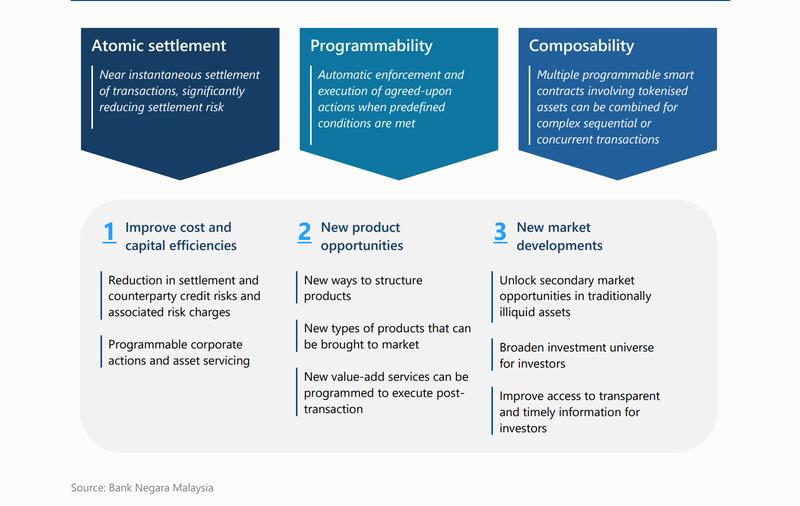
During November 2025, government officials in Kuala Lumpur released a three-year strategic roadmap designed to evaluate asset tokenization throughout multiple real-world industry sectors.
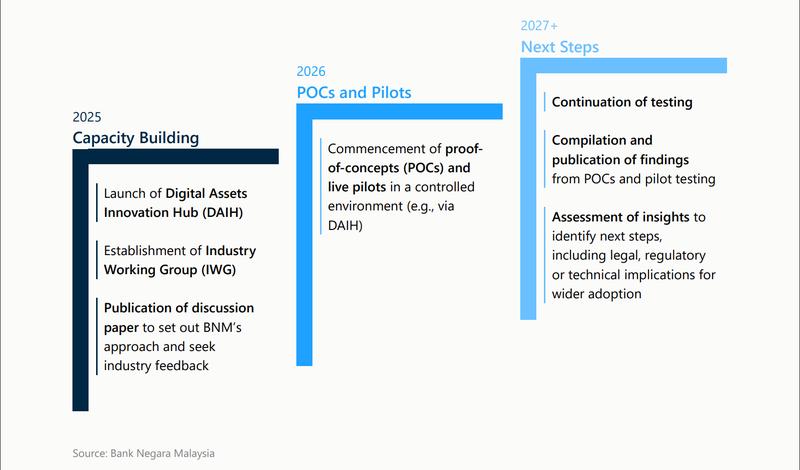
The practical applications identified included supply chain oversight, financial products compliant with Shariah principles, expanded credit accessibility, programmable finance capabilities and round-the-clock cross-border settlement operations, as outlined in a discussion paper released by BNM.
Malaysia's crown prince, Ismail Ibrahim, introduced a stablecoin pegged to the ringgit during December under the ticker symbol RMJDT.
This stablecoin was created by Bullish Aim, a telecommunications company under Ibrahim's ownership, though it remains within the regulatory sandbox evaluation phase and has not yet been made available for public trading.
During that same month, Standard Chartered Bank alongside Capital A revealed their intentions to develop a ringgit-pegged stablecoin designed for wholesale settlement purposes.
Stablecoins and CBDCs designed for wholesale use are intended for institutional settlement transactions between authorized entities such as nation-states or central banking authorities and are not designed for retail consumer use.