
Ripple and Saudi Arabia's Riyad Bank forge blockchain collaboration for payments and custody
The partnership between Ripple and Riyad Bank underscores increasing institutional adoption of blockchain technology for payment solutions, custody services and tokenization throughout worldwide financial systems.

A collaboration has been established between Ripple and Jeel, the innovation division of Riyad Bank—one of Saudi Arabia's premier financial institutions—to investigate blockchain technology applications within the nation's banking sector, demonstrating heightened institutional interest in blockchain-powered infrastructure.
Monday marked the official announcement of this collaboration through Reece Merrick, who serves as Ripple's senior executive officer and managing director overseeing the Middle East and Africa regions. According to Merrick, Ripple's engagement with Jeel, the innovation subsidiary of Riyad Bank, forms part of a strategic agreement designed to examine various use cases for blockchain technology.
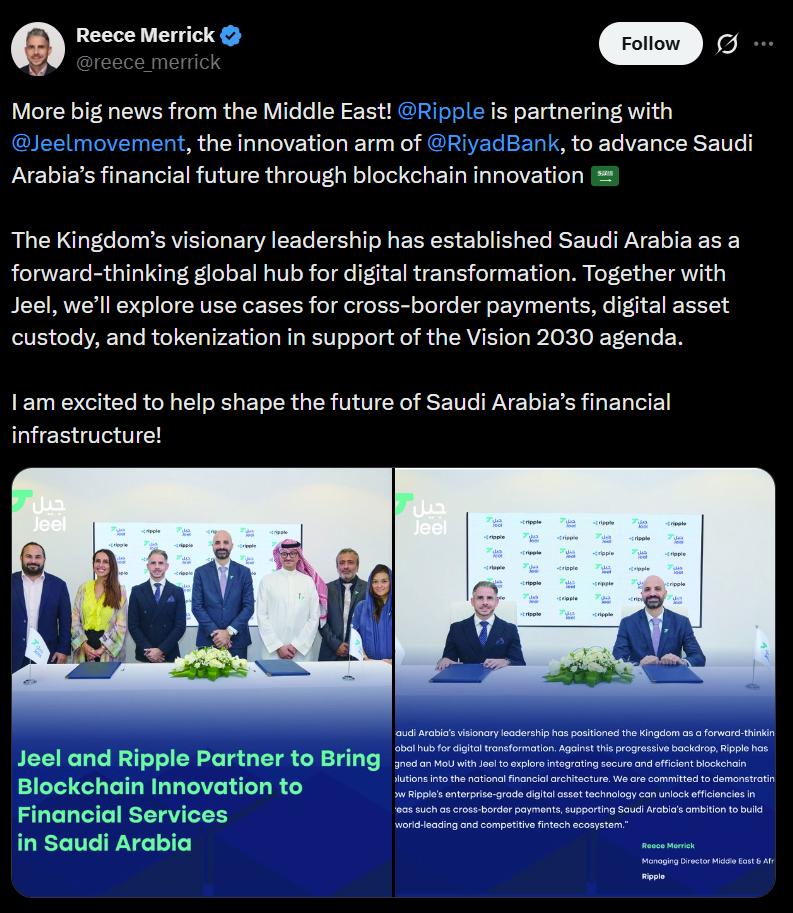
Structured as a memorandum of understanding, the collaboration will concentrate on international payment transfers, custody solutions for digital assets and the tokenization of various assets. These initiatives are designed to advance Vision 2030, the Kingdom of Saudi Arabia's comprehensive blueprint for economic transformation and financial sector modernization, alongside efforts to reduce reliance on petroleum-based revenue streams.
The significance of this partnership stems from Riyad Bank's substantial presence and influence within Saudi Arabia's banking landscape. Ranking among the nation's most prominent lending institutions, the bank maintains assets exceeding $130 billion as recorded in mid-2025, establishing it as a critical player in any widespread transition toward blockchain-enabled financial solutions.
Middle East is emerging as a major market for digital asset innovation
Despite Saudi Arabia's traditionally conservative stance regarding blockchain technology adoption, the wider Middle Eastern region is advancing more aggressively in this space, with the United Arab Emirates serving as the primary catalyst.
Through a combination of more transparent regulatory structures and proactive collaboration with international corporations, the UAE has established itself as the region's digital asset epicenter.
Authorities in both Dubai and Abu Dhabi have implemented specialized regulatory frameworks for digital assets that encompass trading platforms, custody service providers and stablecoin issuance entities, offering businesses a more defined operational pathway within conventional financial markets. This regulatory clarity has drawn significant industry leaders seeking compliant entry points to the Middle Eastern market and adjacent territories.
As part of this broader movement, Ripple has bolstered its UAE operations. The firm has obtained regulatory authorization for its Ripple USD (RLUSD) stablecoin, which targets institutional applications including payment processing and transaction settlement.
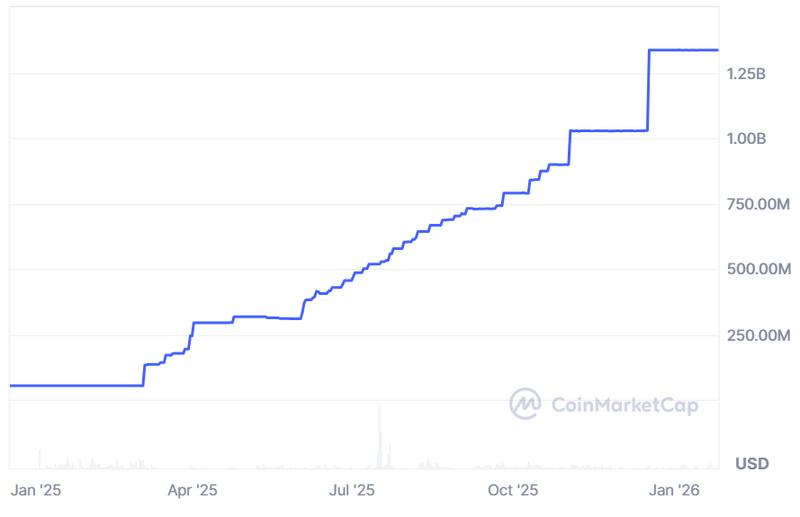
In addition to regional progress, tokenization activities on public blockchain networks are experiencing worldwide expansion. Recently, the XRP Ledger crossed the $1 billion threshold in onchain tokenized assets, demonstrating accelerated institutional utilization of blockchain-based systems.
This upward trajectory has resulted from a mix of tokenized United States Treasury instruments and investment funds, combined with the expansion of RLUSD, which has commenced trading on prominent exchanges, including Binance.