
Bitcoin Miners Face Survival Challenge Without Active BTC Strategies: Wintermute
Market maker Wintermute advises that cryptocurrency miners experiencing declining profitability and compressed margins need to explore AI infrastructure services and dynamic treasury strategies for continued viability.

Numerous Bitcoin mining operations are finding it challenging to maintain profitability during the current market cycle as returns continue to shrink, leading market maker Wintermute to suggest they should consider transitioning to artificial intelligence infrastructure services or actively deploying their coin reserves to earn yields.
In a blog post published on Thursday, Wintermute highlighted that Bitcoin (BTC) mining operations have invested years constructing massive power infrastructure facilities in regions with affordable energy costs, and these companies are now "sitting on exactly what the AI industry needs most urgently and cannot easily replicate."
The market maker characterized Bitcoin mining as a "structurally rigid business model," noting that while transitioning to AI represents an attractive opportunity, such a move constitutes a "drastic and capital-intensive step."
This analysis emerges as mining behemoth MARA Holdings becomes the most recent company to explore AI opportunities, submitting documentation with the SEC on March 3 that indicates its intention to liquidate portions of its BTC reserves to fund the technological pivot. In parallel, publicly traded mining companies have offloaded more than 15,000 Bitcoin since October.
Miners hanging onto Bitcoin is "legacy of the HODL era"
According to Wintermute, Bitcoin mining operations are collectively retaining nearly 1% of the entire BTC supply, which the firm characterized as a "legacy of the HODL era," adding that the "full toolkit of treasury management remains largely untapped."
Cryptocurrency yield generation has historically been confined to staking and DeFi platforms, but Wintermute suggested miners could access yields through active management strategies, including monetizing market risk through derivatives structures, covered calls, and cash-secured puts.
For passive management approaches, miners have options that include deploying BTC into lending protocols to earn interest.
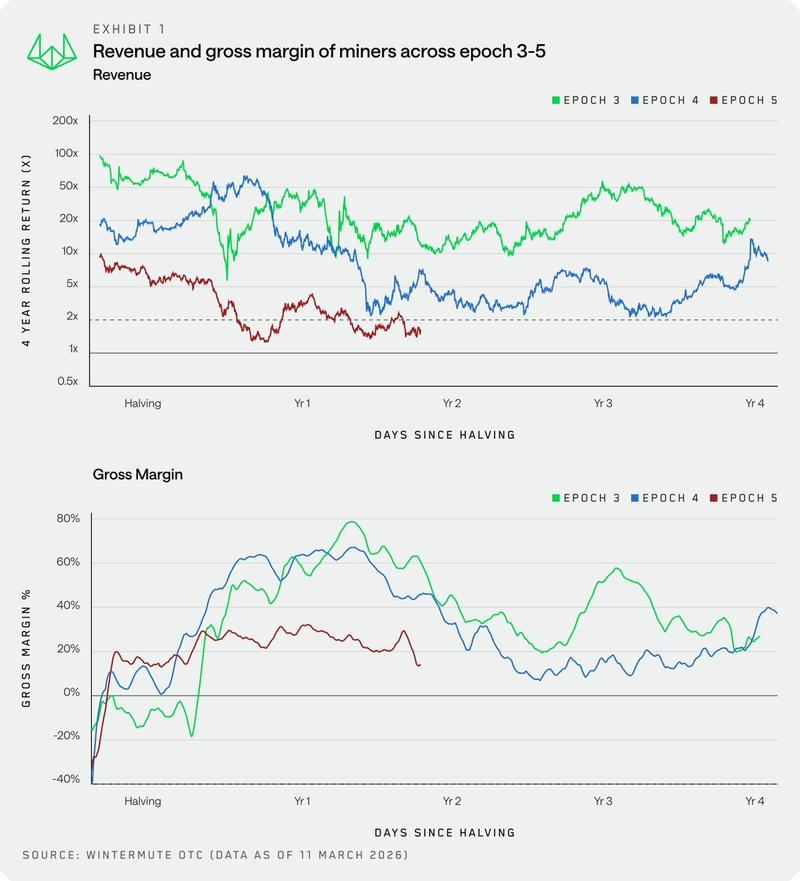
"We believe active balance sheet management is the most underutilized lever available to miners and one that deserves far greater strategic attention," Wintermute said. "The miners who treat their BTC holdings as a working asset rather than a passive reserve will carry a structural edge into the next halving."
The market maker observed that for the first time within a four-year market cycle, Bitcoin has failed to deliver the two-times price return needed to offset halving-driven revenue cuts, and gross margins have peaked at levels that previously marked bear market floors.
Furthermore, the transaction fee market has failed to compensate for the shortfall as it remains "episodic" rather than structural. Simultaneously, energy costs continue to squeeze margins.
The company pointed out that available data indicates this squeeze differs from previous cycles in 2018 and 2022, characterizing it as a "healthy shakeup" that aligns with the design of Bitcoin and will make the mining industry "more efficient as a result."