Tezos Tallinn Protocol Update Goes Live, Cutting Block Production Time to 6 Seconds
Tallinn represents the 20th significant protocol enhancement for Tezos since its 2018 inception, achieved without requiring a network fork.

The layer-1 proof-of-stake blockchain network Tezos rolled out its newest protocol enhancement, Tallinn, this past Saturday, bringing down block production times on its base layer to just 6 seconds.
This newest enhancement represents the 20th protocol modification to the network, delivering reduced block production times, decreased storage expenses, and lower latency, which collectively contribute to accelerated network finality times, as stated in a Tezos announcement.
The Tallinn upgrade additionally enables every network validator, referred to as "bakers," to provide attestation for each individual block, moving away from the previous protocol versions where only a subset of validators would attest to blocks. Representatives for Tezos provided this explanation:
This is achieved through the use of BLS cryptographic signatures, which aggregate hundreds of signatures into just one per block. By lightening the load on nodes, it also opens the door to further block time reductions.
The protocol enhancement has also brought in an address indexing mechanism designed to eliminate "redundant" address information, which decreases storage requirements for applications operating on Tezos.
Representatives for Tezos indicated that the address indexing mechanism enhances storage efficiency by a factor of 100.
The most recent upgrade from Tezos demonstrates the industry-wide drive toward faster and higher-throughput blockchain networks capable of processing more transactions per second and achieving reduced settlement times to support an expanding range of use cases.
Block times have come a long way since the first generation of blockchains
Early blockchain networks, such as Bitcoin and Ethereum, operated at speeds of approximately seven transactions per second (TPS) and 15-30 TPS, respectively.
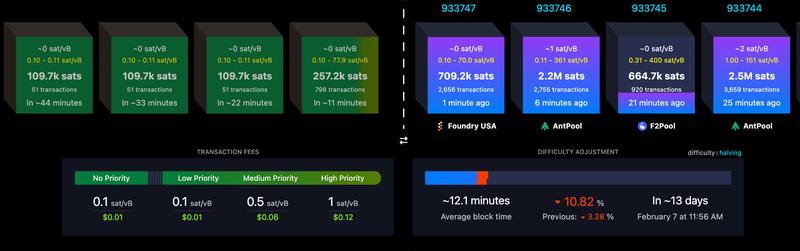
The Bitcoin protocol generates blocks approximately every 10 minutes, creating an obstacle for everyday payments and commercial transactions conducted on the base layer.
Such slow network speeds have driven both protocols to pursue scaling through layer-2 (L2) networks, which are responsible for handling transaction execution.
For Bitcoin, this scaling is accomplished through the Lightning Network, which consists of payment channels established between two or more parties that process a series of transactions off-chain, posting only the final net balance to the base layer when the payment channel is closed.
The Ethereum network depends on an ecosystem of layer-2 networks for scaling purposes, and adopts a modular approach, dividing the execution, consensus and data availability layers.
Monolithic blockchain networks, such as Solana, consolidate all these functions into a single layer, rather than scaling through L2's.