Sustained Bitcoin Price Gains Unlikely Without Market Liquidity Boost: Analysis
Lack of adequate bid-side liquidity prevents Bitcoin price breakouts from maintaining momentum. Key metrics highlighted in Glassnode's research point to indicators that could signal the beginning of BTC's next major price rally.

Bulls in the Bitcoin (BTC) market successfully defended against prices falling into the support territory between $80,700 and $83,400, with futures market indicators suggesting a possible short-term liquidity capture around the $93,500 level. While near-term sentiment appears bullish, researchers at Glassnode maintain that a meaningful and sustained recovery won't materialize until a critical liquidity indicator crosses a specific threshold.
Key takeaways:
- Currently, more than 22% of Bitcoin's total supply is being held at an unrealized loss, which heightens the market's vulnerability to support level breaches.
- BTC deposits flowing into Binance continue to hover near levels last observed in 2020, which helps minimize immediate selling pressure.
Market liquidity emerges as critical Bitcoin indicator
According to a post shared on X by Glassnode, the focus of market participants has pivoted toward liquidity metrics following Bitcoin's successful defense of the support band ranging from $80,700 to $83,400. For a shift toward a durable and sustained upward movement to materialize, it needs to be mirrored in indicators that measure liquidity sensitivity, most notably the realized profit/loss ratio tracked on a 90-day moving average basis.
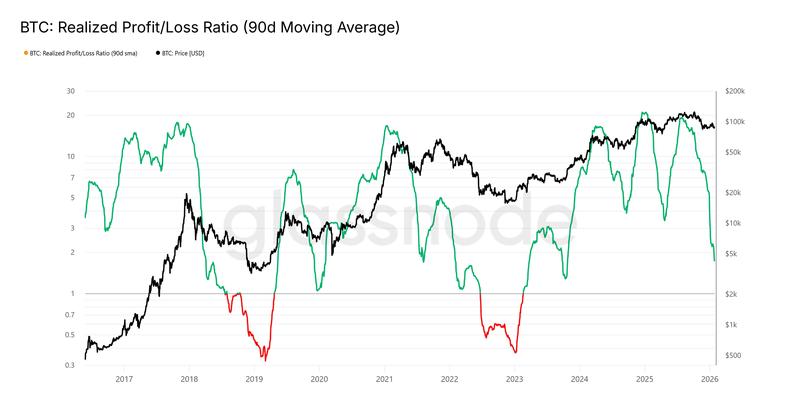
Significant price rebounds, including those mid-cycle recoveries witnessed during the previous two years, have only taken shape after this ratio remained consistently above the 5 threshold. When this metric achieves such levels, it has historically served as a reliable signal indicating fresh liquidity entering the market and capital flowing back into Bitcoin assets.
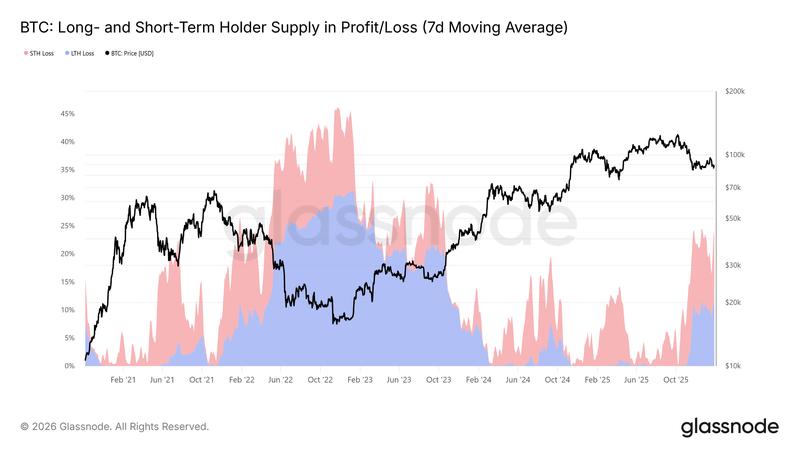
The research from Glassnode further emphasized the increasing pressure being placed on BTC supply dynamics. At present, over 22% of all circulating Bitcoin tokens are being held at unrealized losses, a situation that was previously observed during Q1 2022 and Q2 2018.
Such conditions elevate the risk of price corrections, and should Bitcoin prove unable to maintain its critical support thresholds, particularly the −1 standard deviation band associated with short-term holder cost basis alongside the true market mean, there's potential for renewed selling activity from long-term holders to emerge.
Exchange flow patterns continue to indicate holding behavior
Information from CryptoQuant reveals minimal selling activity at this time, with monthly Bitcoin deposits flowing into Binance averaging approximately 5,700 BTC. This figure represents less than half of the historical long-term average that stands at around 12,000 BTC, marking the weakest inflow levels recorded since 2020.
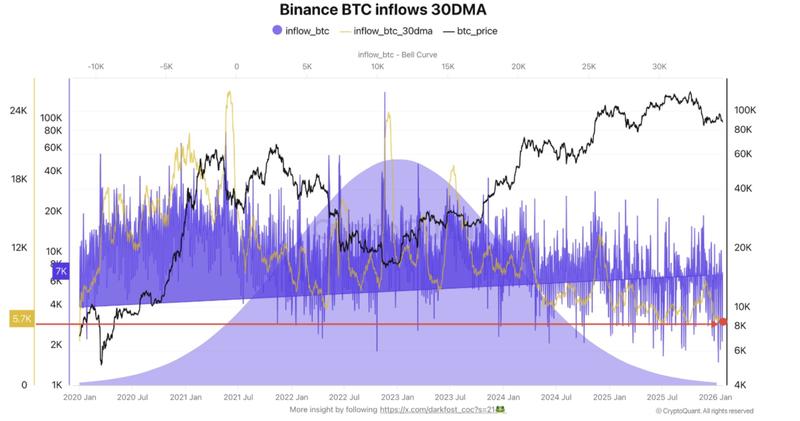
Given that inflows to exchanges are typically correlated with selling intentions, the ongoing low levels of deposits indicate that market participants are choosing to hold their positions rather than positioning themselves to liquidate assets.
While this pattern diminishes near-term downside threats, it doesn't substitute for the necessity of liquidity verification. Cryptocurrency analyst Darkfost provided additional context,
"This historically low level of BTC inflows represents a rather positive signal. Despite a period of Bitcoin consolidation and growing macroeconomic uncertainty, investors appear more inclined to hold their BTC."