Stablecoin Illicit Transactions Reach Record $141B in 2025, TRM Labs Reports
According to TRM Labs, criminal networks obtained $141 billion through stablecoins in 2025, with networks evading sanctions representing 86% of total illicit cryptocurrency transactions.
Criminal organizations obtained approximately $141 billion through stablecoins during 2025, marking the highest amount recorded over the past five years, according to blockchain analytics company TRM Labs.
In a report published on Tuesday, TRM indicated that this surge doesn't necessarily represent an expansion in cryptocurrency-facilitated criminal activity overall, but rather demonstrates a "deeper reliance on stablecoins within specific activity types where they offer clear operational advantages."
The firm noted that stablecoins have seen particularly heavy adoption among networks circumventing sanctions and large-volume money transfer operations.
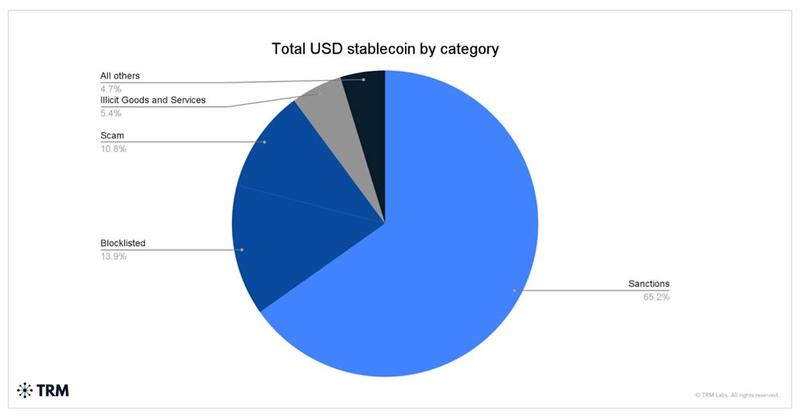
Activity related to sanctions evasion represented 86% of total illicit cryptocurrency transactions in 2025. From the $141 billion in stablecoin transactions, approximately half, amounting to $72 billion, was connected specifically to A7A5, a Russian ruble-backed token, "whose activity is almost entirely concentrated within sanctions-linked ecosystems," according to TRM.
Networks connected to Russia, including one designated as A7, overlap with other state-associated ecosystems, comprising entities linked to China, Iran, North Korea, and Venezuela, "underscoring how stablecoins have become a connective infrastructure for sanctioned actors seeking to move value outside traditional financial controls," TRM explained.
Guarantee marketplaces exclusively on stablecoins
In contrast, fraudulent schemes, ransomware operations, and hacking incidents demonstrate more selective stablecoin adoption, frequently preferring Bitcoin (BTC) or alternative cryptocurrency assets initially before transitioning to stablecoins during subsequent money laundering stages.
The analysis also highlighted that sectors including illicit goods and services trade and human trafficking displayed "near-total stablecoin usage," indicating these underground markets "prioritize payment certainty and liquidity over price appreciation."
Transaction volume on guarantee marketplace platforms like Huione climbed to more than $17 billion by the end of 2025, with stablecoins comprising the dominant payment method.
"The fact that roughly 99% of this volume is denominated in stablecoins reinforces the role these services play as laundering infrastructure, not speculative venues," the researchers stated.
Chainalysis published findings earlier in February showing that cryptocurrency transactions to suspected human trafficking operations grew 85% year over year in 2025. International escort operations and prostitution rings functioned almost entirely utilizing stablecoins, according to their observations.
TRM Labs documented that overall stablecoin transaction activity surpassed $1 trillion in monthly volume on multiple occasions throughout 2025.
Estimating this figure annually results in approximately $12 trillion, which means that criminal usage represents roughly 1% of the overall total.
When compared with the United Nations estimation, the volume of illicit funds laundered worldwide annually ranges from 2% to 5% of global GDP, or approximately $800 billion to $2 trillion.