Prediction market platforms face Utah ban amid escalating state-federal regulatory conflict
Michael Selig, Chairman of the CFTC, has stated the agency maintains jurisdiction over platforms such as Kalshi and Polymarket, cautioning that legal action will follow any challenges to this authority.

Prediction market platforms including Kalshi and Polymarket are poised to be prohibited in the US state of Utah, intensifying an expanding conflict between federal authorities and state-level regulators regarding proper oversight of this emerging industry.
Utah's HB243 legislation, titled Gambling Revisions, reached the governor's office on Wednesday following approval by the Utah House on Feb. 10 and passage through the Senate on Feb. 27. The legislation classifies "proposition betting" as a form of gambling. These proposition wagers involve betting on specific occurrences during a game—such as individual player performance metrics or whether teams achieve particular statistical benchmarks—as opposed to wagering on the game's ultimate result.
This legislative measure aims to prohibit organizations from providing sports-connected prediction markets or proposition wagering within Utah's borders, encompassing platforms that identify themselves as prediction markets instead of traditional sportsbooks.
According to a Thursday Associated Press report, Governor Spencer Cox has indicated his intention to approve the legislation. "We are putting a casino in the pocket of every single American, and they are targeting especially young people," Cox reportedly said. "It is really awful what they are doing, and we are going to make sure this doesn't happen in our state," he added.
Kalshi sues Utah after Senate passes bill
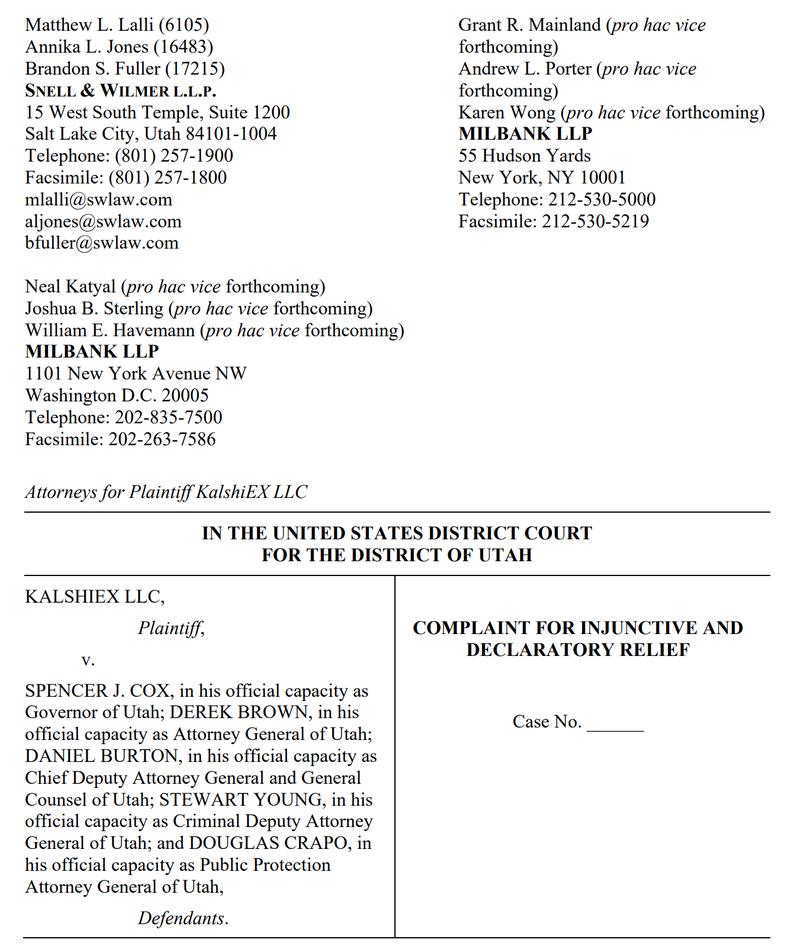
Following the Utah Senate Business and Labor Committee's unanimous approval of the HB243 legislation in February, Kalshi initiated legal proceedings against Utah, requesting a federal judge prevent the state from applying its gambling regulations to the platform.
Kalshi contended that its event contracts constitute federally regulated derivatives rather than gambling products. The platform asserted that the Commodity Futures Trading Commission (CFTC) possesses exclusive jurisdiction over such markets under provisions of the Commodity Exchange Act, thereby preventing states like Utah from implementing prohibitions against them.
Additionally, on Wednesday, Kalshi filed a lawsuit against Iowa, asserting the action became necessary due to the possibility of imminent enforcement measures. This development follows a Monday decision by an Ohio federal judge who rejected Kalshi's petition to prevent state regulatory officials from applying gambling legislation to its sports event contract offerings.
CFTC claims authority over prediction markets
The CFTC has proclaimed its regulatory jurisdiction extends to prediction markets. "To those who seek to challenge our authority in this space, let me be clear, we will see you in court," Chairman Michael Selig said recently.
During remarks delivered at an industry conference held in Florida on Monday, Selig additionally stated that prediction markets possess potential as robust instruments for uncovering information regarding future occurrences. He characterized properly functioning prediction markets as "truth machines," maintaining that when market participants support their perspectives with financial stakes, these markets can produce transparent and accountable indicators that may prove more dependable than conventional opinion polling methods.