CoinShares: Merely 10,000 BTC Face Quantum Threat Significant Enough to Warrant Attack
The majority of Bitcoin vulnerable to quantum computing attacks resides in smaller wallets containing fewer than 100 BTC, which CoinShares estimates would require roughly a thousand years each to breach.

Asset management firm CoinShares has dismissed worries that quantum computing technology might imminently disrupt the Bitcoin ecosystem, maintaining that only a minimal portion of coins reside in wallets that would justify targeting.
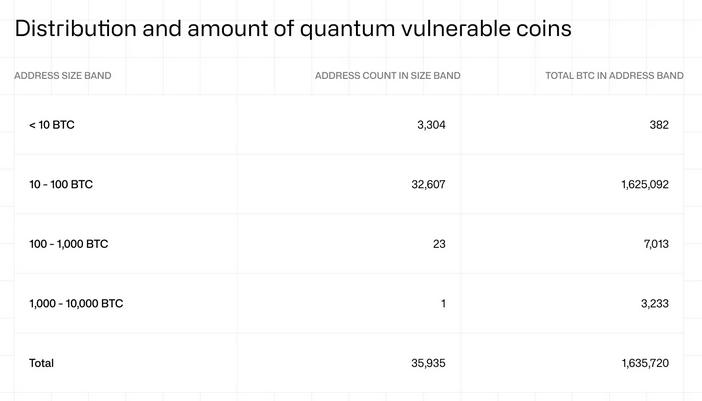
During a Friday announcement, Christopher Bendiksen, who leads Bitcoin research at CoinShares, contended that merely 10,230 Bitcoin (BTC) out of 1.63 million Bitcoin exist in wallet addresses featuring publicly exposed cryptographic keys susceptible to quantum computing assaults.
Approximately 7,000 Bitcoin exist within wallets containing between 100 and 1,000 BTC, whereas around 3,230 Bitcoin reside in wallets storing 1,000 to 10,000 BTC, totaling $719.1 million based on present market valuations, an amount Bendiksen suggested might even appear as a standard trading volume.
The balance of 1.62 million Bitcoin exists in wallets containing holdings below 100 BTC, which Bendiksen asserted would require a millennium each to crack, even under the "most outlandishly optimistic scenario of technological progression in quantum computing."
According to the CoinShares analyst, these "theoretical risks" originate from quantum algorithms like Shor's, which has the potential to compromise Bitcoin's elliptic-curve signatures, along with Grover's, which might diminish the effectiveness of the Secure Hash Algorithm 256-bit (SHA-256).
Nevertheless, he contended that neither quantum algorithm possesses the capability to modify Bitcoin's 21 million supply cap or circumvent proof-of-work, which represent two of the most fundamental characteristics of the Bitcoin network.
Concerns surrounding quantum computing have emerged as one of several catalysts for Bitcoin FUD (fear, uncertainty, doubt) throughout recent months, with detractors cautioning that any breach of its cryptographic foundations could jeopardize a network presently safeguarding $1.4 trillion in value.
The vulnerable Bitcoin consists of unspent transaction output (UTXO) wallets, which represent portions of Bitcoin associated with wallet addresses that remain unspent. A significant number of these at-risk Bitcoin wallets originate from the Satoshi era.
This matter has created division within the Bitcoin community regarding whether to deploy a quantum-resistant hard fork or adopt a wait-and-see approach.
Certain Bitcoin advocates, including Strategy executive chairman Michael Saylor and Blockstream CEO Adam Back, maintain that quantum threats are exaggerated and will not compromise the network for several decades.
Bendiksen aligns with these perspectives, declaring that Bitcoin remains "nowhere near dangerous territory," emphasizing that breaking its cryptographic protection would demand millions of fault-tolerant qubits — presently far exceeding the 105 qubits accomplished by Google's most recent quantum computer, Willow.
"Recent advancements, including demonstrations by Google and others, represent progress but fall short of the scale needed for real-world attacks on Bitcoin."
Conversely, figures such as Capriole Investments founder Charles Edwards regard quantum computing as a possible "existential threat" to Bitcoin, maintaining that an upgrade should be implemented immediately to bolster network security.
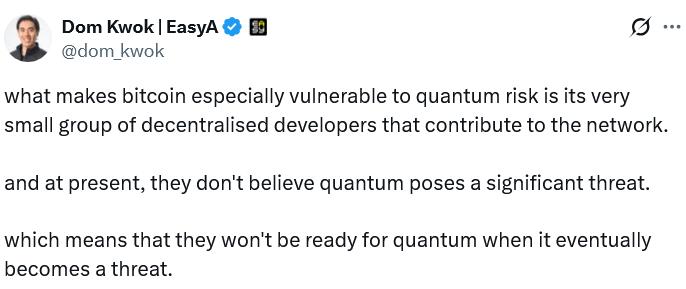
Edwards indicated Bitcoin might experience substantial revaluation upward following the implementation of a solution, which certain experts, including Blockstream researcher Jonas Nick, propose could entail the integration of post-quantum signatures.