British Parliament Initiates Stablecoin Investigation While Central Bank Finalizes Comprehensive Regulatory Framework
A new parliamentary investigation unfolds amid regulatory concerns that stablecoins may significantly impact traditional bank deposits and transform the payments landscape.

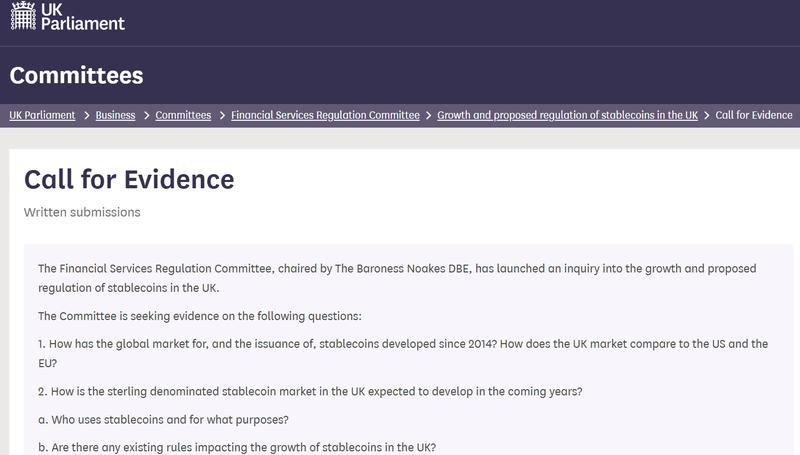
A fresh investigation into proposed regulatory frameworks for stablecoins has been initiated by the House of Lords Financial Services Regulation Committee in the United Kingdom, calling for contributions from the public regarding proposals developed by the Financial Conduct Authority (FCA) and the Bank of England (BoE).
According to a Thursday announcement from the committee, the investigation will scrutinize the potential impact of stablecoins on conventional financial services including payments and banking, while also evaluating both the risks and opportunities presented by their increasing adoption throughout the UK.
The review aims to determine whether regulatory frameworks put forth by the Financial Conduct Authority and the Bank of England offer "measured and proportionate responses" to the evolving stablecoin marketplace, as stated by committee chair Baroness Noakes.
Until March 11, the committee welcomes written submissions from the general public, industry experts, and participants. On Wednesday, a public hearing is set to take place where the committee will gather oral testimony.
Bank of England to finalize systemic stablecoin rules by end of 2026
This investigation emerges while British authorities proceed with developing their strategy for overseeing stablecoins.
According to the Bank of England, progressing stablecoin regulatory frameworks will rank among its highest priorities throughout 2026, in addition to initiatives involving tokenized collateral and its Digital Securities Sandbox program.
Speaking about collaborative efforts with the FCA, Sasha Mills, who serves as executive director of financial market infrastructure at the BoE, explained that the central bank is developing a framework for systemic stablecoins designed to guarantee they satisfy identical standards as current forms of money utilized within the UK's economic system.
During her address at Thursday's Tokenisation Summit, she outlined plans that would grant systemic stablecoins access to deposit accounts at the Bank of England, while simultaneously exploring the establishment of a liquidity facility serving as a safety net for those issuing stablecoins, with completion targeted for year-end.
"We aim to finalise the regime for systemic stablecoins, working side-by-side with the FCA, by the end of this year."
Classified as pound sterling-denominated stablecoins utilized for UK payments that may pose threats to financial stability, systemic stablecoins must maintain full backing with a minimum of 40% of their reserves maintained in deposits at the BoE, as outlined in the consultation paper the central bank released in November 2025.
Mills further noted that expanding stablecoin adoption has the potential to diminish bank deposits throughout the nation and contribute to decreased credit availability for the "real economy."
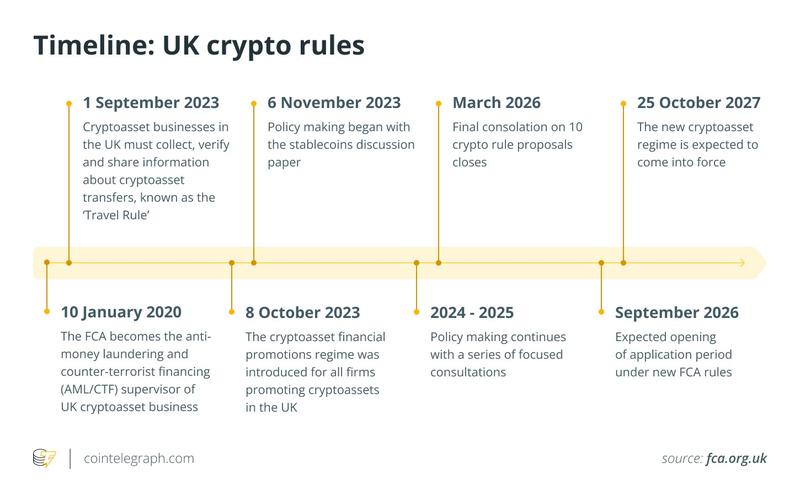
This investigation arrives on the heels of recent regulatory actions from the FCA, which has published a final consultation outlining 10 proposals that address crypto markets. The regulator anticipates wrapping up that process in March, with complete implementation scheduled for October 2027.
Within the UK's regulatory framework, oversight of crypto activities would be consolidated under the FCA, which functions as both the nation's commodities and securities regulatory authority.
By comparison, the United States' forthcoming market structure framework, known as the CLARITY Act — which incorporates provisions addressing payment stablecoins — aims to establish distinct boundaries separating the regulatory authority of the Commodity Futures Trading Commission and the Securities and Exchange Commission concerning digital assets.